
- On October 23, 2026
- In ABOUT VILLA BORGHESE Art collections
Susanna and the Elders: Rubens, Artemisia, and the Story Behind the Paintings
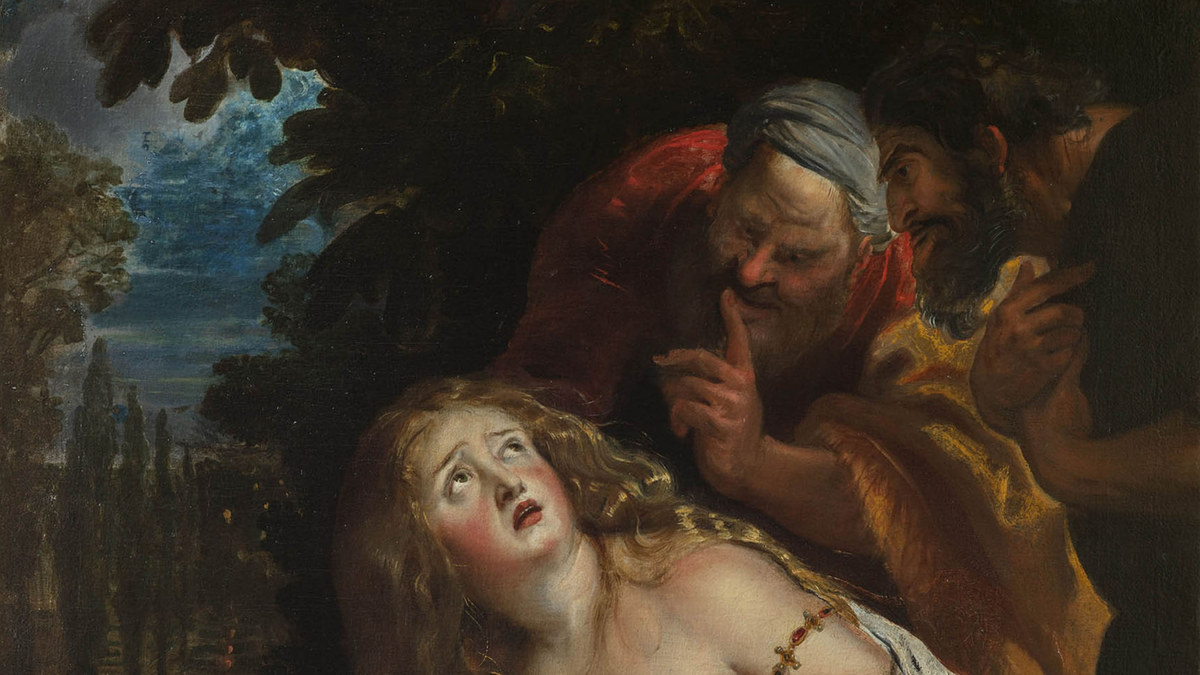
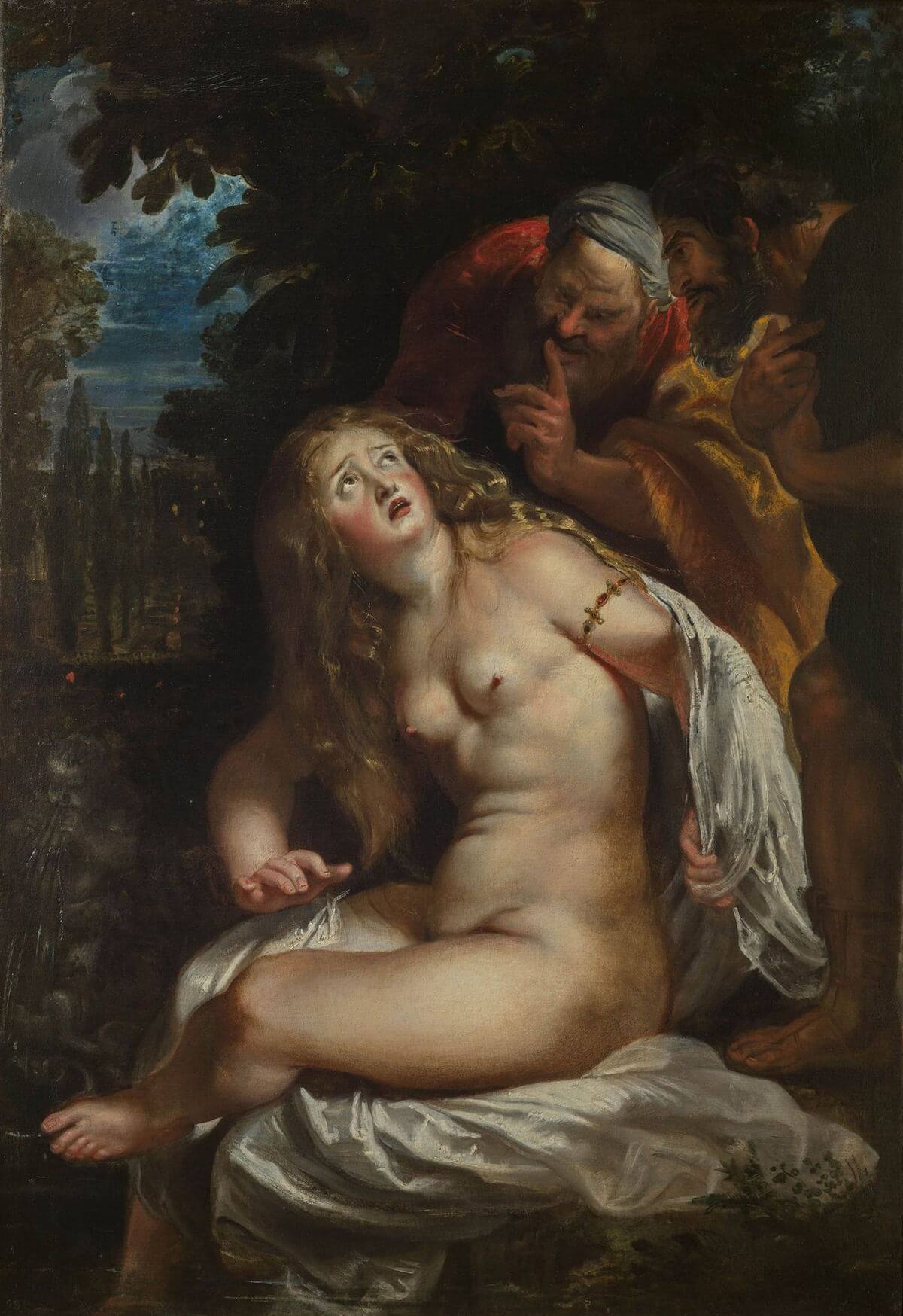
One elder presses a finger to his lips while Susanna turns on her seat and lifts her face upward. In Susanna and the Elders by Peter Paul Rubens, her extended leg crosses the foreground as the two men lean close behind her. They are judges threatening to accuse her of adultery unless she agrees to have sex with them.
Painted around 1606–1607, the canvas belongs to the Borghese Gallery in Rome and is kept in its storerooms. It shares its subject with Artemisia Gentileschi’s painting of 1610, now in Pommersfelden, Germany. In Artemisia’s version, Susanna raises both arms between herself and the men leaning over the wall above her.
Susanna and the Elders by Rubens: Key Facts
- Artist: Peter Paul Rubens
- Italian title: Susanna e i Vecchioni
- Date: c. 1606–1607
- Medium: Oil on canvas
- Dimensions: 94 × 67 cm (height × width), about 37 × 26 inches
- Subject: Susanna threatened by two elders while bathing
- Collection: Galleria Borghese, Rome; inventory number 277
- Display status: Kept in the museum’s storerooms
The Story and Meaning of Susanna and the Elders
The story of Susanna, also spelled Susannah, appears in the additions to the Book of Daniel, numbered Daniel 13 in Catholic Bibles. Susanna is the wife of Joakim, a wealthy man living in Babylon. Two elders appointed as judges become obsessed with her and hide in the garden where she bathes.
When her maids leave, the men approach her with an ultimatum: have sex with them, or they will testify that they caught her with a young lover. Their authority makes the threat especially dangerous. The men responsible for administering justice intend to use it against her.
Susanna refuses and cries out. The elders carry out their threat, and the assembly believes them and condemns her to death. Daniel intervenes before the execution and insists on questioning the accusers separately. Asked under which tree they saw the supposed adultery, one names a mastic tree and the other an evergreen oak. Their conflicting answers expose the lie. Susanna is cleared, and the elders receive the death sentence they had tried to impose on her.
Susanna’s vindication made her an example of virtue protected by divine justice in Christian interpretation. Rubens depicts the earlier confrontation in the garden, before Daniel intervenes.
Rubens’ Susanna: A Closer Look
The Finger to the Lips and Susanna’s Response
Rubens groups the two elders in the upper right of the canvas, their heads close together above Susanna. One presses a finger against his lips while the other looks down toward her. Within the biblical story, the gesture becomes a demand for silence from one of the men threatening her.
Below them, Susanna’s leg stretches across the foreground while her torso turns and her face lifts upward. Her mouth is open, and her hands are held apart, one beside the white cloth. The men lean in while her body turns away, making their pressure and her response visible through the opposing movements.
The figures occupy most of the canvas. A narrow view of sky and distant landscape opens at the left, but dark foliage closes around the group above their heads.
Light, Skin, and the White Cloth
Susanna’s skin and the white cloth form the brightest areas against the dark garden. Light falls across her shoulder, torso, and thigh, making the seated figure easy to follow. The elders’ red and gold clothing emerges more dimly from the shadows behind her.
Look at the fabric across the stone seat: bright folds alternate with narrow, dark creases. Beside her arm, the cloth hangs in longer folds. These sharp changes between light and shadow contrast with the softer shading across her torso, helping distinguish the smooth skin from the gathered fabric.
A Sculptural Pose and a Link with Bernini
The Borghese catalog connects Susanna’s seated pose with the ancient Spinario, or Boy with a Thorn, in Rome’s Capitoline Museums. The boy bends forward over a foot resting on his opposite knee. Susanna’s head turns upward toward the men behind her, introducing a twist through the neck and torso into the seated pose.
The catalog also identifies Susanna’s twisting movement as a source for Bernini’s later Rape of Proserpina. Susanna turns on her seat beneath the elders; Bernini’s Proserpina twists away from Pluto’s grip and pushes against his face. The turn of the body expresses resistance in both works, while Proserpina’s pushing hand makes her attempt to break free particularly explicit.
Rubens’ Susanna in the Borghese Collection
Rubens painted the canvas during his second stay in Rome. It is unclear whether Cardinal Scipione Borghese commissioned it or acquired it after it was painted.
A payment recorded in 1622 for a frame for a painting of Susanna may refer to this canvas. By 1650, the painting was in the collection: Jacopo Manilli listed it as a work by Rubens in his guide to Villa Pinciana.
Rubens and Artemisia Gentileschi Compared
Artemisia Gentileschi’s Susanna and the Elders of 1610, now in the Schloss Weißenstein collection at Pommersfelden, Germany, is her earliest signed and dated painting.
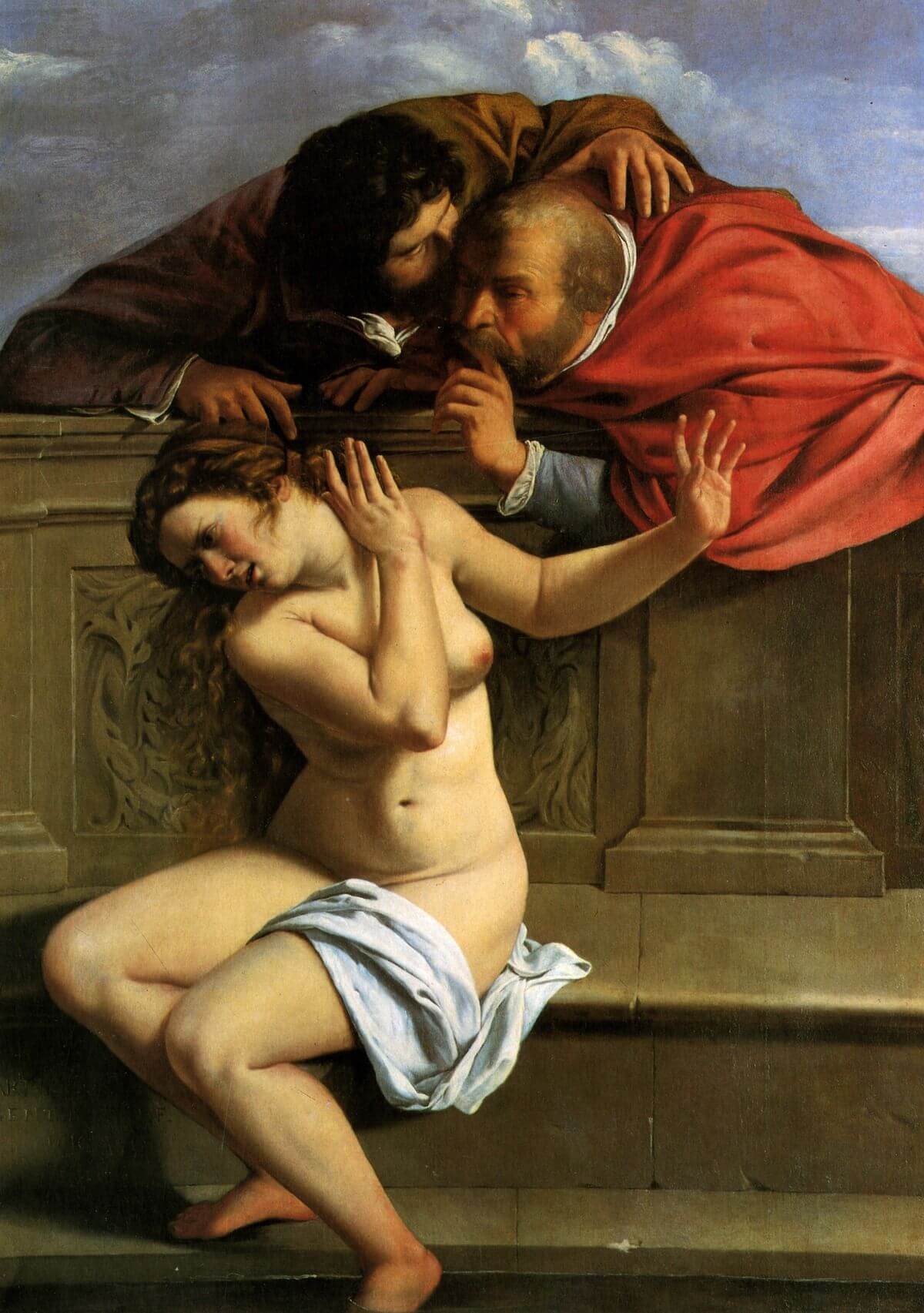

Artemisia gives Susanna two raised arms and an averted face. One palm opens toward the men while the other hand rises beside her head. In Rubens’ painting, her hands remain lower and farther apart, while her torso twists and her face turns upward toward the elders. Artemisia makes the defensive movement of the arms more prominent.
The men loom above Susanna in both paintings. Artemisia places them behind a stone wall, leaning over its edge toward the woman seated below. The wall separates their bodies, but their faces come close to hers. Rubens groups the elders behind Susanna against dark foliage, with a narrow opening onto the landscape at the left.
Both painters include an elder with a finger to his lips, connecting the gesture to the demand for silence in the biblical story. In Artemisia’s painting, Susanna’s raised arms reject the men’s approach without concealing her torso. The viewer sees her exposed body and her refusal together.
The 1610 painting predates the sexual assault Artemisia suffered in 1611. It belongs to the beginning of her career, and she returned to the subject in several later paintings.
Other Versions of Susanna and the Elders
There is another Susannah and the Elders in the Borghese collection: Gerrit van Honthorst’s painting of 1655, inventory 027. It is a different, much wider composition, also cataloged in the museum’s storerooms.
Tintoretto: Susanna Unaware of the Watchers
Tintoretto’s painting of 1555–1556, in the Kunsthistorisches Museum in Vienna, places Susanna beside a mirror in a spacious garden. She studies her reflection while the elders spy on her. As the museum’s interpretation explains, the viewer notices the intruders before she does. Rubens shows Susanna already turning toward the men; Tintoretto lets us recognize the danger while she remains unaware of it.
Rembrandt: A Composition Reworked Over Time
Rembrandt worked on his Susanna and the Elders, now in Berlin’s Gemäldegalerie, in several stages from around 1635 to 1647, revising the composition as he went. The museum’s research also identified later alterations by the English painter and collector Joshua Reynolds, who subsequently owned the painting.
Guido Reni: A Struggle over the Drapery
In Guido Reni’s version of about 1622–1623, in London’s National Gallery, one elder grabs Susannah’s robe and presses his fingers to his lips. She grips the drapery to cover her breasts. The gesture of silence also appears in Rubens, but Reni makes the struggle over the cloth explicit: the man pulls at the covering she is trying to hold in place.
Another Rubens Composition in Print
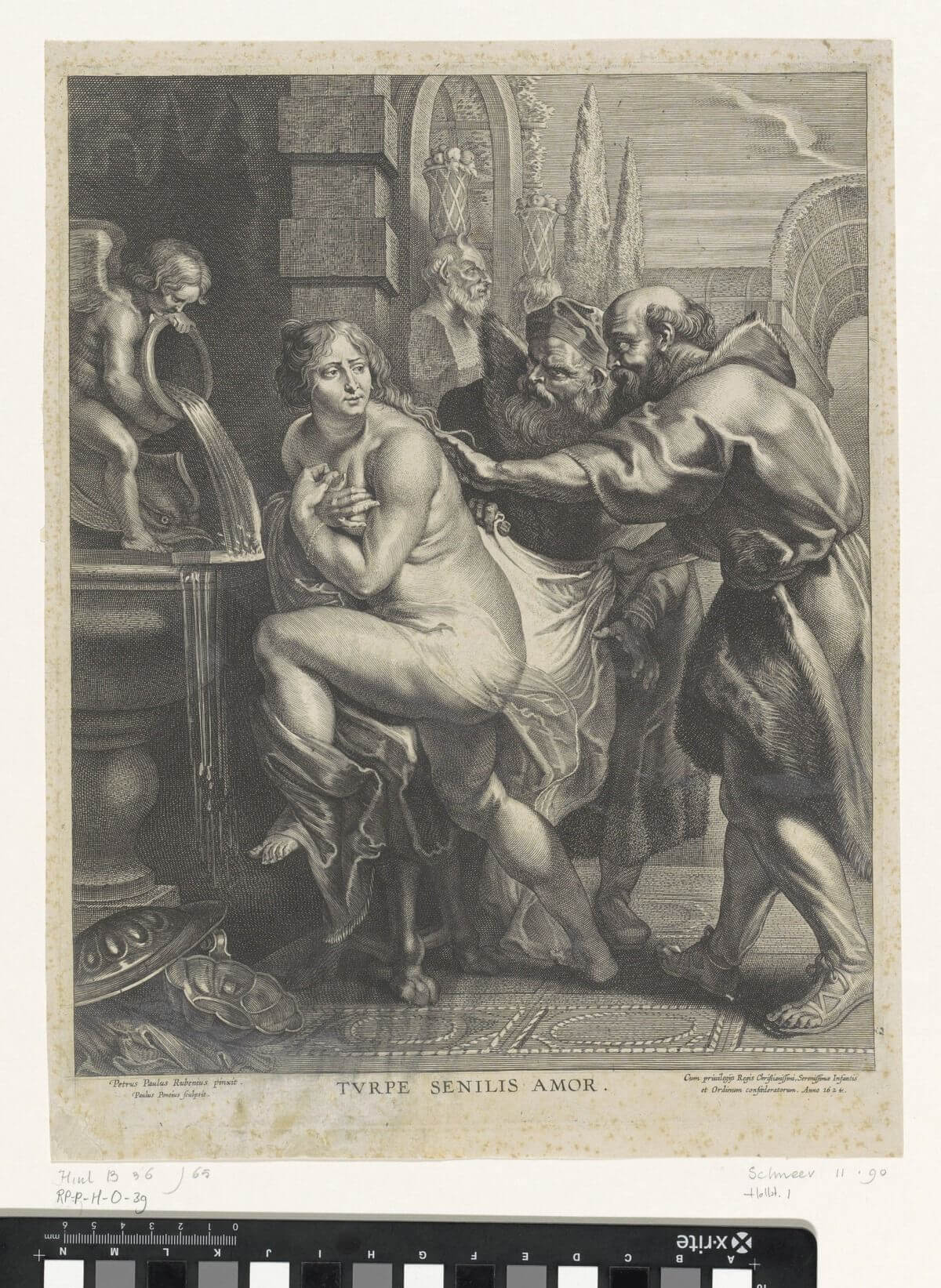
A 1624 engraving by Paulus Pontius after Rubens, in the Rijksmuseum, shows a different composition from the Borghese canvas. Susanna draws her arms across her chest as one elder pulls at the fabric behind her. Her crossed arms shield her body, unlike the lower, separated hands of Susanna in the Rome painting.
Can You See Rubens’ Susanna at the Borghese Gallery?
Rubens’ Susanna and the Elders is kept in the museum’s storerooms, and storeroom tours are currently suspended. If this painting is the main reason for your visit, confirm its availability with the museum before booking.
You can examine the painting in the museum’s online catalog. Start with the elders leaning over Susanna and the turn of her torso away from them. Then compare her brightly lit skin and white cloth with the dark foliage behind her: the contrast makes her exposed figure stand out against the garden.
 For other paintings and sculptures to include in your visit, explore our Borghese Gallery artworks guide. Read our Borghese Gallery tickets guide for booking options and practical advice.
Sources
- Galleria Borghese — Rubens, Susanna and the Elders: Pier Ludovico Puddu’s catalog entry, dated June 2022, covering the painting’s dating, provenance, sculptural influences, and connection with Bernini’s Rape of Proserpina.
- Museum With No Frontiers — Susanna and the Old Men: Sofia Barchiesi’s discussion of Rubens’ second stay in Rome and the subject’s religious interpretation.
- The Bible — Daniel 13, NRSV Catholic Edition, via Bible Gateway: the account of Susanna’s refusal, the false accusation, and Daniel’s questioning of the elders.
- National Gallery — Artemisia Gentileschi: the identification and location of her 1610 painting, with the chronology of her early career and the assault she suffered in 1611.
- Royal Collection Trust — Rediscovered Artemisia Painting: research published in September 2023 documenting a later Susanna and the Elders and Artemisia’s repeated treatment of the subject.

Fanny, a skilled writer with a keen interest in art and culture, has been enchanted by the Borghese Gallery’s exquisite collection and its history. As a significant contributor to the Visit Borghese Gallery blog, she artfully shares insights and stories, bringing the gallery’s masterpieces and the lush gardens to life for readers around the world.