
- On October 26, 2026
- In ABOUT VILLA BORGHESE Art collections
Paolina Borghese as Venus Victrix: Canova’s Portrait of Napoleon’s Sister
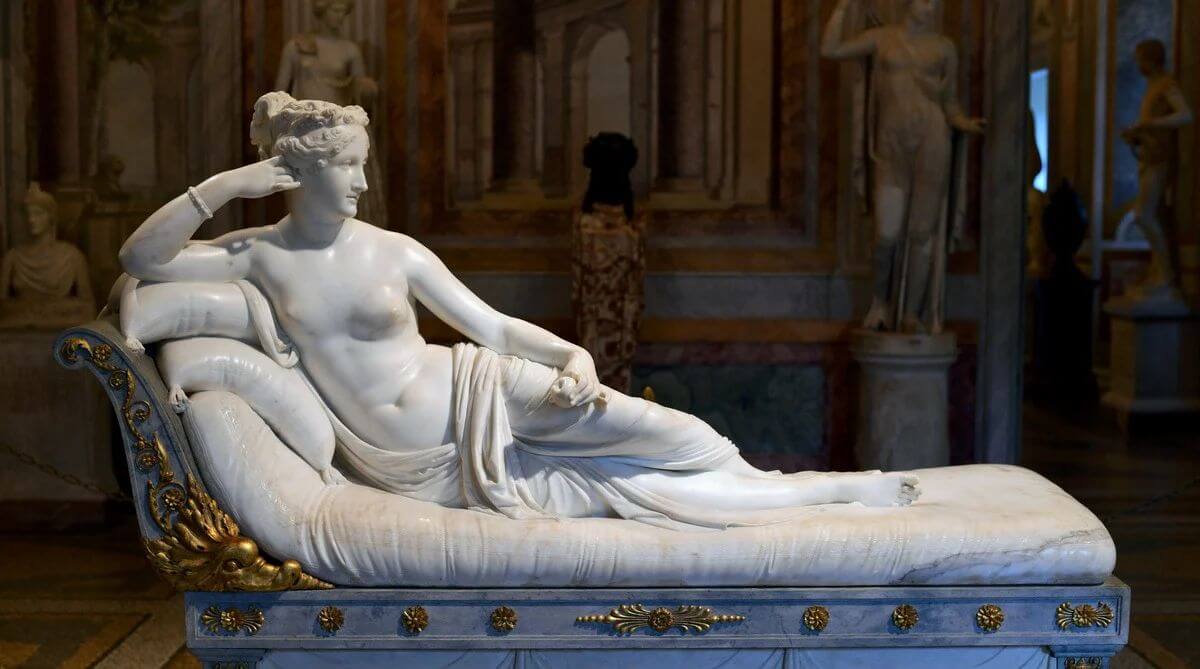
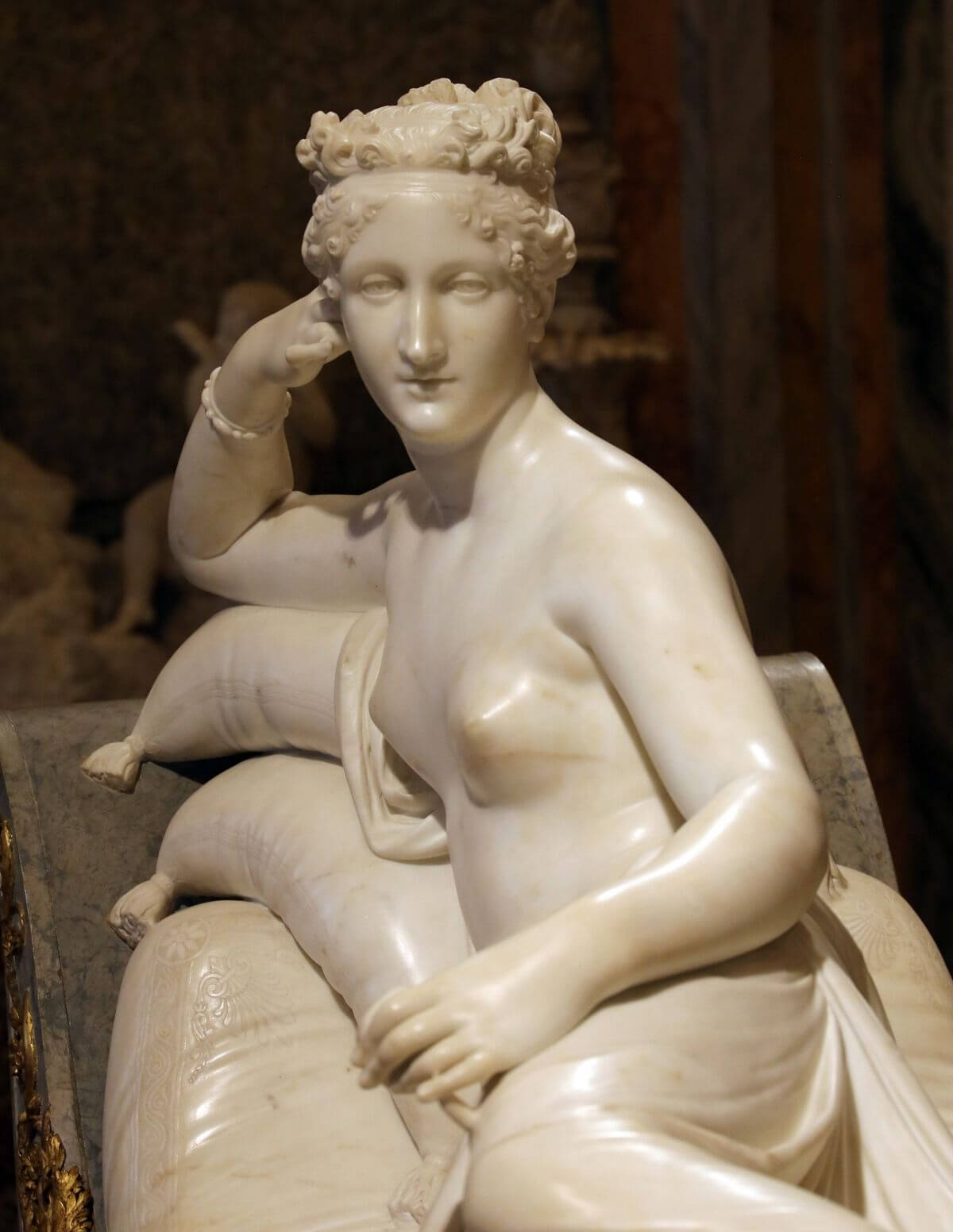
A small apple rests in her left hand, while her right hand touches the back of her head. In Paolina Borghese as Venus Victrix, Antonio Canova shows Napoleon’s sister reclining bare-breasted on a cushioned couch. The apple identifies her as Venus, the goddess who won the prize for beauty in the Judgment of Paris.
Carved in 1804–1808, the marble portrait is displayed in Room 1 of Rome’s Borghese Gallery. Its smooth skin, sharply folded cloth, and yielding mattress make the same hard stone suggest several different materials.
Paolina Borghese as Venus Victrix: Key Facts
- Artist: Antonio Canova (1757–1822).
- Italian title: Paolina Borghese Bonaparte come Venere vincitrice.
- Date: 1804–1808, as listed in the museum’s object record.
- Material: Carrara marble, with a painted and gilded wooden base.
- Height: 92 cm for the figure; 160 cm including the bed.
- Commissioned by: Prince Camillo Borghese, Pauline’s husband.
- Location: Room 1, the Paolina Room, on the ground floor of the Borghese Gallery in Rome.
Pauline Bonaparte, Portrayed as Venus
Pauline Bonaparte (1780–1825), known in Italy as Paolina, was Napoleon’s younger sister. In 1803 she married Prince Camillo Borghese, joining the Bonaparte family to one of Rome’s established aristocratic houses. Camillo commissioned her portrait from Canova the following year.
Canova was a leading sculptor of Neoclassicism, a style that drew on ancient Greek and Roman art. Here he combined a recognizable sitter with the body, pose, and attributes of a goddess. The result is a mythological portrait: Pauline’s identity and Venus’s beauty occupy the same figure.
What Does Venus Victrix Mean?
Venus Victrix means “Venus Victorious.” The apple explains her victory. In the Greek myth of the Judgment of Paris, the Trojan prince chose Venus over Juno and Minerva as the most beautiful goddess and awarded her a golden apple.
Canova gives Pauline that identifying attribute. The apple in the sculpture is carved in marble; the gold belongs to the myth. Her relaxed pose and uncovered torso draw on an established tradition of reclining Venuses, rather than illustrating the contest itself.
The pose also recalls ancient figures reclining on sarcophagus lids and the Venuses painted by Titian. These connections help explain how a contemporary princess could be presented through forms that viewers associated with antiquity and celebrated art.
Reading Canova’s Marble
Her right elbow rests on the cushions, raising the shoulder and supporting the turned head. Below the torso, the cloth gathers into narrow folds across her hips and legs. The polished skin catches broad areas of light, while the grooves in the drapery hold thin shadows. The contrast makes flesh and fabric look different even though both are stone.
For a different use of contrasting surfaces, compare Bernini’s Apollo and Daphne: smooth skin gives way to rough bark and thin leaves.
Look at the mattress beneath her body. Its upper surface dips under her weight, while its thick edge bulges outward. That apparent compression makes the reclining figure feel physically present. The museum’s catalogue connects the mattress to the one Bernini carved for the Sleeping Hermaphrodite formerly in the Borghese collection, now in the Louvre.
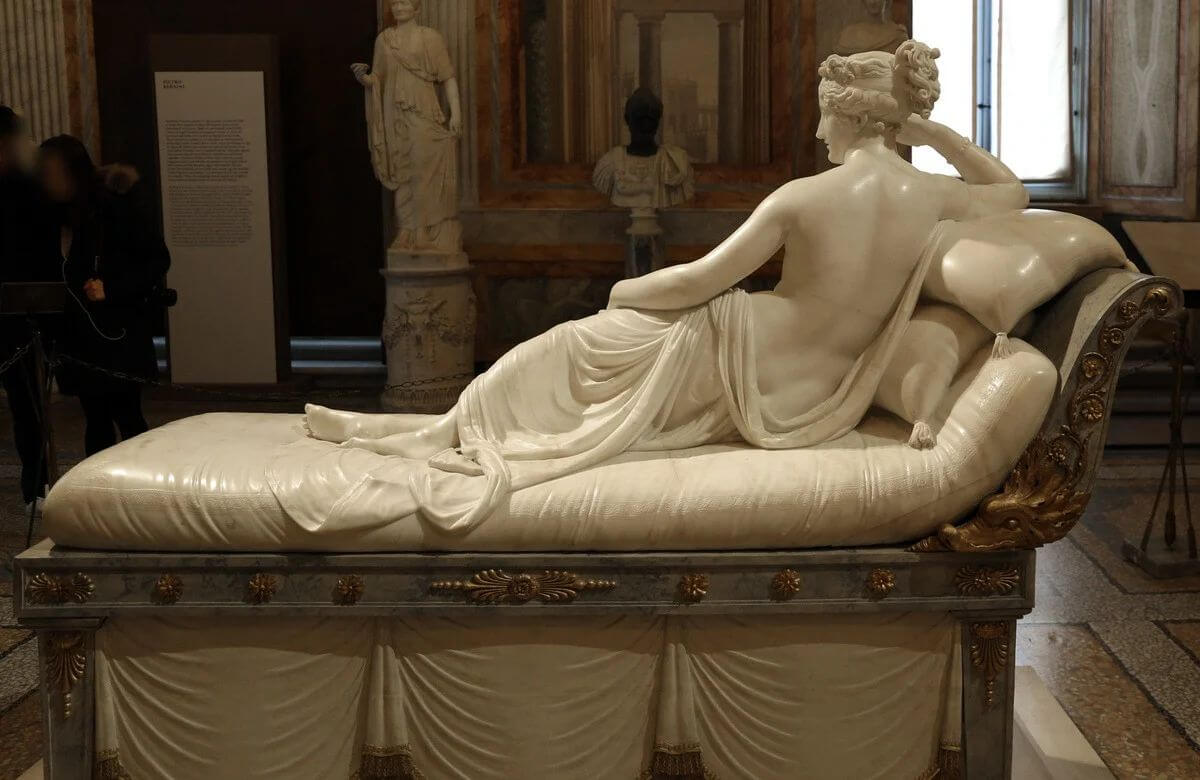
Canova worked with assistants who helped translate his models into marble; he reserved the finishing work for himself. The Borghese catalogue describes the use of acqua di rota, water used to cool iron grinding wheels, to give this sculpture a faint rosy sparkle. Its highly polished surfaces were especially effective under candlelight, when changing light could animate the still figure.
The decorated wooden base conceals a rotating mechanism made in Turin. Historically, it let the statue turn so viewers could see it from different angles while remaining in one place. The mechanism was restored in 1997.
Did Pauline Really Pose Nude?
The sculpture’s nudity does not prove that Pauline posed undressed. Canova created an idealized body, so the marble cannot be treated as a record of what happened in his studio. Rumors circulated during Pauline’s lifetime, but the familiar story that she dismissed the question by mentioning a warm studio remains an anecdote.
Grand Palais’s Panorama de l’art relates that Canova initially considered portraying her as Diana, the chaste huntress, before Pauline chose Venus.
From Camillo’s Palace to the Borghese Gallery
Camillo paid Canova 6,000 scudi on May 15, 1808. The sculpture went to his residence in Turin in 1809, then returned to Rome in 1814 via Genoa. It was displayed at Palazzo Borghese, where torchlight brought out the polished surfaces.
The marble moved to the family’s villa in 1838 and reached its present room in 1889. The Italian state acquired it with the collection in 1902.
Canova’s original plaster model is preserved at the Museo Gypsotheca Antonio Canova in Possagno. That is a separate object from the finished marble in Rome, a distinction to keep in mind when looking at photographs or reading about damage to the plaster.
Seeing Paolina at the Borghese Gallery
Paolina Borghese as Venus Victrix is displayed in Room 1, the Paolina Room, on the ground floor of the Borghese Gallery in Rome.
Begin with the whole reclining figure, then look closely at the mattress beside her hips: its shallow dip and rounded edge make the stone seem to give under her weight. Elsewhere in the gallery, Bernini’s Rape of Proserpina creates a related illusion through Pluto’s fingers pressing into Proserpina’s thigh. The two works give you different ways to compare how carved marble suggests pressure on a softer surface.
Look up at the Judgment of Paris in the center of the ceiling. Domenico de Angelis painted it in 1779, well before Pauline’s portrait was made. The apple in her hand links the sculpture to that earlier scene; the room’s decoration was not created specifically for Canova’s work.
Planning your visit to Paolina
- Admission to the sculpture: Your Borghese Gallery ticket includes Paolina, so there’s no additional artwork ticket to buy.
- Booking your entry: Everyone needs a reserved time slot, including visitors entitled to free admission. Arrive for your chosen slot and allow for entrance checks and any wait before admission.
- Museum schedule: The gallery welcomes visitors Tuesday through Sunday, from 9 a.m. to 7 p.m., with the last entry at 5:45 p.m.
- Time to explore: A standard visit gives you two hours inside the museum. Choose the final 5:45 p.m. entry and you’ll have 75 minutes.
- Closing days: The museum closes on Mondays, January 1, and December 25. Before visiting, check its official visitor information for exceptions and temporary closures.
 Our Borghese Gallery tickets guide explains booking options. Use the Borghese Gallery artworks guide to choose the other works you want to see during your visit.
Sources
- Galleria Borghese collection catalogue — Paolina Borghese Bonaparte as Venus Victrix. Sonja Felici’s January 2024 entry documents the commission, materials, finishing, rotating base, and changes of location. Its object record dates the work to 1804–1808.
- Galleria Borghese — Room 1, Paolina Room. Identifies the ceiling scenes and distinguishes their 1779 date from the sculpture’s installation in 1889.
- Grand Palais, Panorama de l’art — Pauline Borghèse en Vénus. Nathalie Gathelier’s analysis explains the reclining pose, classical precedents, and the reported choice between Diana and Venus.
- Museo Gypsotheca Antonio Canova — Antonio Canova’s biography. Places the portrait within Canova’s work for the Bonaparte family.

Fanny, a skilled writer with a keen interest in art and culture, has been enchanted by the Borghese Gallery’s exquisite collection and its history. As a significant contributor to the Visit Borghese Gallery blog, she artfully shares insights and stories, bringing the gallery’s masterpieces and the lush gardens to life for readers around the world.