

- On October 20, 2026
- In Art collections
Lady with a Unicorn by Raphael: The Portrait and Its Transformations
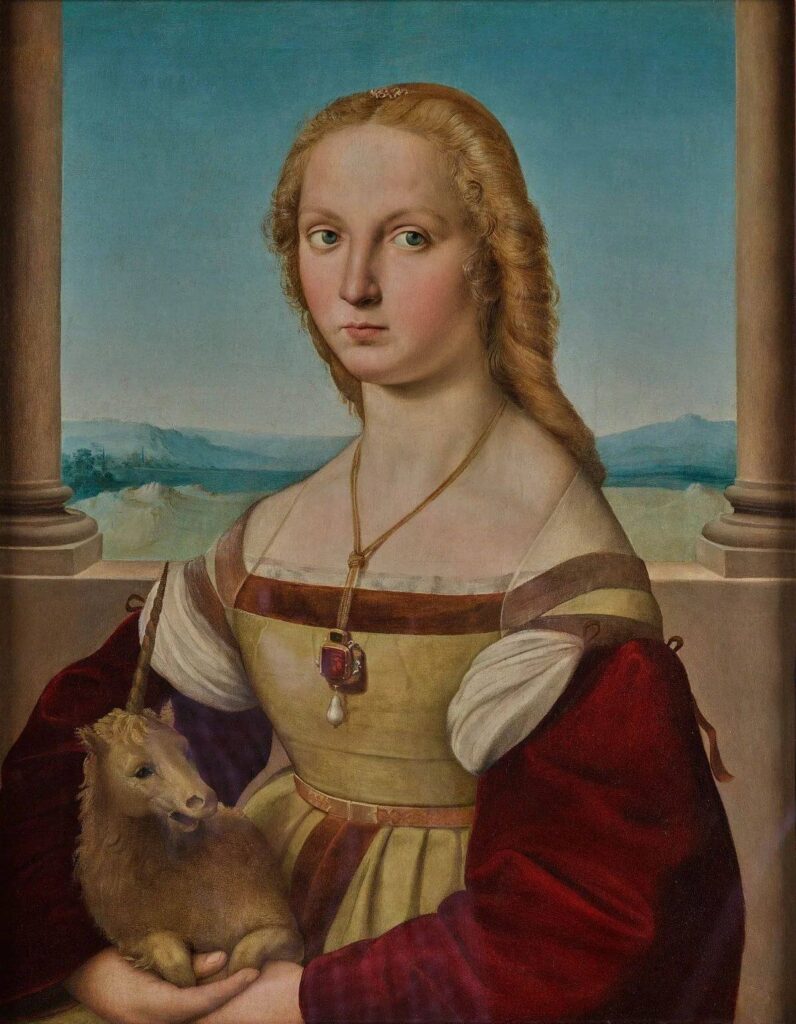
A young woman holds a small unicorn against her lap, its single horn rising beside her red sleeve. Raphael’s Lady with a Unicorn, also known as Portrait of a Young Woman with a Unicorn, is a portrait in Rome’s Borghese Gallery. Before twentieth-century restoration, the same woman appeared as Saint Catherine of Alexandria.
The unicorn suggests chastity, but the sitter’s identity and the portrait’s original purpose remain uncertain. Her gaze, jewelry, and the changes to the painting offer clues to how this young woman was presented—and how later additions turned her into a saint.
Lady with a Unicorn by Raphael: Key Facts
- Artist: Raphael (Raffaello Sanzio, 1483–1520)
- Date: Early 1500s; proposed dates are discussed below
- Medium: Oil on wood panel, transferred to canvas and mounted on a wooden support
- Dimensions: 67 × 56 cm (about 26.4 × 22 inches)
- Subject: An unidentified young woman holding a unicorn
- Collection: Galleria Borghese, Rome; inventory number 371
- Collection location: Room 9, the Dido Room, on the upper floor
Young Woman with a Unicorn: A Closer Look
The Woman’s Gaze and Hands
The woman’s body turns slightly to one side, while her face remains directed toward us. Her gaze meets the viewer’s, and her closed lips give her expression a restrained quality.
Her arms curve around the unicorn resting in her lap. One hand supports its body, while the other holds it close. Beside the broad red sleeve, its pale head and slender horn are easy to pick out. The imaginary creature rests in her arms like a small pet, bringing an unexpected detail into the formal pose.
Clothing, Jewelry, and Landscape
The broad red sleeves contrast with the lighter fabric around her shoulders. The fitted bodice follows the shape of her torso, while the fuller sleeves widen the figure on either side. These differences help distinguish the layers of clothing.
At the center of her chest, a red stone hangs above a drop-shaped pearl. Their colors echo the red sleeves and the pale tones of her skin and clothing. The elaborate dress and pendant present the sitter as a woman of wealth and status.
Behind her, two columns frame a view of distant hills and sky. The landscape sits low enough to leave her face clearly outlined against the pale background. Her body fills the foreground, while the small, distant features open a sense of space beyond her.
Raphael and the Mona Lisa
The turned body, folded arms, and distant landscape recall Leonardo da Vinci’s Mona Lisa. Raphael encountered Leonardo’s work during his years in Florence, when he was developing his own approach to portraiture.
The unicorn changes the arrangement of the hands. In the Mona Lisa, one hand rests over the other; here, the woman’s hands hold and support the animal. Following her arms leads our eyes toward the creature, giving us a second subject to examine alongside the sitter.

What Does the Unicorn Mean?
The unicorn is a traditional symbol of chastity. According to the legend, only a virgin could tame the creature. Its calm presence in the young woman’s arms connects her with that ideal.
This association has led scholars to interpret the painting as an engagement or marriage portrait. The unicorn would emphasize the sitter’s virtue, while her elaborate clothing and jewelry would display her wealth and social standing. Together, these details present qualities valued in a prospective bride.
A marriage connection remains an interpretation: the portrait’s original commission has not been established. The unicorn helps explain the ideal represented in the painting, but it does not identify the woman.

Who Is the Young Woman?
The sitter remains unidentified, although scholars have proposed several names.
The Metropolitan Museum of Art suggests Laura Orsini della Rovere, daughter of Giulia Farnese. The unicorn’s association with the Farnese family offers a possible connection to Laura through her mother.
Art historian Angela Coliva has proposed Maddalena Doni before her marriage, an identification recorded in the Borghese catalogue. Neither identification has been established.
Questions about a sitter’s identity also surround Raphael’s La Fornarina, another portrait of a young woman, now at Palazzo Barberini in Rome.
Restoration and Changes to the Painting
From a Portrait to Saint Catherine
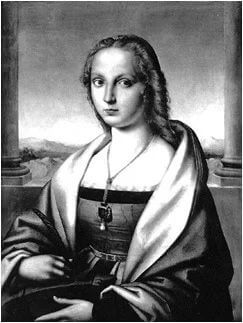
Later additions transformed the young woman into Saint Catherine of Alexandria. A wheel and a martyr’s palm identified the saint, while a painted mantle covered the woman’s shoulders. These details gave the portrait a religious identity.
Giulio Cantalamessa questioned the additions in 1916. Restoration in 1934–1936 removed the later paint and revealed the unicorn, allowing the woman to be seen again as a portrait sitter rather than a saint.
Was There a Dog Beneath the Unicorn?
A dog may once have rested in the woman’s lap. The Borghese catalogue identifies one beneath the unicorn in X-rays taken in 1959–1960. But that interpretation is disputed: BBC Culture reported in April 2026 that the Met’s Raphael exhibition curators questioned whether a dog was ever there.
Who painted the animals is also unresolved. Diagnostic specialist Maurizio Seracini has proposed that Raphael originally painted the woman with empty hands and that other artists added the animals later. His research, summarized by TED, challenges the familiar account of Raphael replacing a dog with a unicorn.
The two animals suggest different virtues: marital fidelity for the dog, chastity for the unicorn. Whether the portrait was altered to shift that emphasis remains unknown.
Dating and Attribution to Raphael
The portrait dates from the early 1500s, although its exact year remains uncertain. The Metropolitan Museum of Art dates it to 1505–1506, while the Borghese catalogue discusses dates between 1506 and 1509.
Angela Coliva’s proposed identification of the sitter as Maddalena Doni before her marriage would place the painting slightly earlier, around 1504–1505. The question of when it was painted is therefore partly connected to whom it represents.
The attribution has also changed. In 1833, the Borghese inventory listed the painting as a Saint Catherine from the school of Perugino. Roberto Longhi’s attribution to Raphael in 1927 gained broad acceptance after restoration revealed the portrait beneath the later additions. The Galleria Borghese now attributes the painting to Raphael.
How to See Lady with a Unicorn at the Borghese Gallery
Young Woman with a Unicorn is normally displayed in Room 9, the Dido Room, on the upper floor of the Borghese Gallery in Rome.
Begin a few steps back to take in the figure between the two columns, with the distant landscape opening behind her. Then move closer to examine the red stone and drop-shaped pearl of the pendant. Their colors echo the broad red sleeves and pale fabric. Look beside the sleeve for the unicorn’s small head and slender horn.
Practical information
- Opening hours: Tuesday–Sunday, 9 a.m.–7 p.m.; last admission at 5:45 p.m.
- Visit duration: Standard museum visits last two hours; the final 5:45 p.m. entry is shorter.
- Reservations: Required for all ticket categories, including free admission. No separate ticket is needed for this painting.
- Before visiting: Check the museum’s official visit notices for temporary changes.
 See our Borghese Gallery tickets guide for booking options. To plan the rest of your visit, explore our guide to the Borghese Gallery artworks.
Sources
- Galleria Borghese — Lady with Unicorn: Marina Minozzi’s catalogue entry, dated June 2024, for dimensions, dating, attribution, restoration, and unresolved questions.
- The Metropolitan Museum of Art — Raphael: A Life in Nine Objects: Caroline Elenowitz-Hess’s 2026 discussion of the possible sitter and marriage imagery.
- Fondazione 1563 — Mostre e restauri: Vincenzo Sorrentino’s account of how the Saint Catherine additions were recognized and removed.

Fanny, a skilled writer with a keen interest in art and culture, has been enchanted by the Borghese Gallery’s exquisite collection and its history. As a significant contributor to the Visit Borghese Gallery blog, she artfully shares insights and stories, bringing the gallery’s masterpieces and the lush gardens to life for readers around the world.