

- On November 19, 2026
- In PLAN YOUR VISIT Top attractions
Mausoleum of Augustus in Rome: A Guide to the Imperial Tomb
Just off Via del Corso, the Mausoleum of Augustus is a vast circular tomb with an unexpected past. Built for Rome’s first emperor and his family, it later became a fortress, a garden, and even a concert hall.
The interior is closed for restoration, but you can explore Piazza Augusto Imperatore and view the monument from outside. Here’s how to understand the ruins, find traces of their past, and plan your visit around the spaces that are open.
Mausoleum of Augustus Key Facts
- Location: Piazza Augusto Imperatore, in Rome’s Campo Marzio district, outside Villa Borghese.
- Italian name: Mausoleo di Augusto.
- Original purpose: A dynastic tomb for Augustus and his family.
- Size: About 285 feet (87 meters) in diameter, the largest known circular tomb of the ancient world.
- Access: The interior is closed to visitors for restoration. The surrounding piazza is open to the public and free to explore.
Is the Mausoleum of Augustus Open to Visitors?
The interior of the Mausoleum of Augustus is closed to visitors. You can still explore Piazza Augusto Imperatore and see the monument from outside for free.
Restoration and Reopening Plans
The mausoleum reopened in 2021, then closed again on June 6, 2022. The final restoration phase began in 2025, with work on the burial chamber, the interior spaces, lighting, and accessibility. A new visitor route is also planned through the planted circular area within the monument.
The restoration project is scheduled for completion by the end of 2026.

Tickets, Tours, and Opening Hours
- Interior visits: Admission and guided visits remain suspended.
- Bookshop: Open daily, 10 a.m.–7 p.m.
The 2026 rates for admission after the works are €7 full price and €4 reduced for nonresidents, including the applicable city tax. A €1 booking fee is listed separately in the official Roma Pass price list.
Residents of Rome and its metropolitan area qualify for free admission under the municipal eligibility rules, with proof of residence.
What to See at Piazza Augusto Imperatore?
The Circular Ruins and the New Piazza
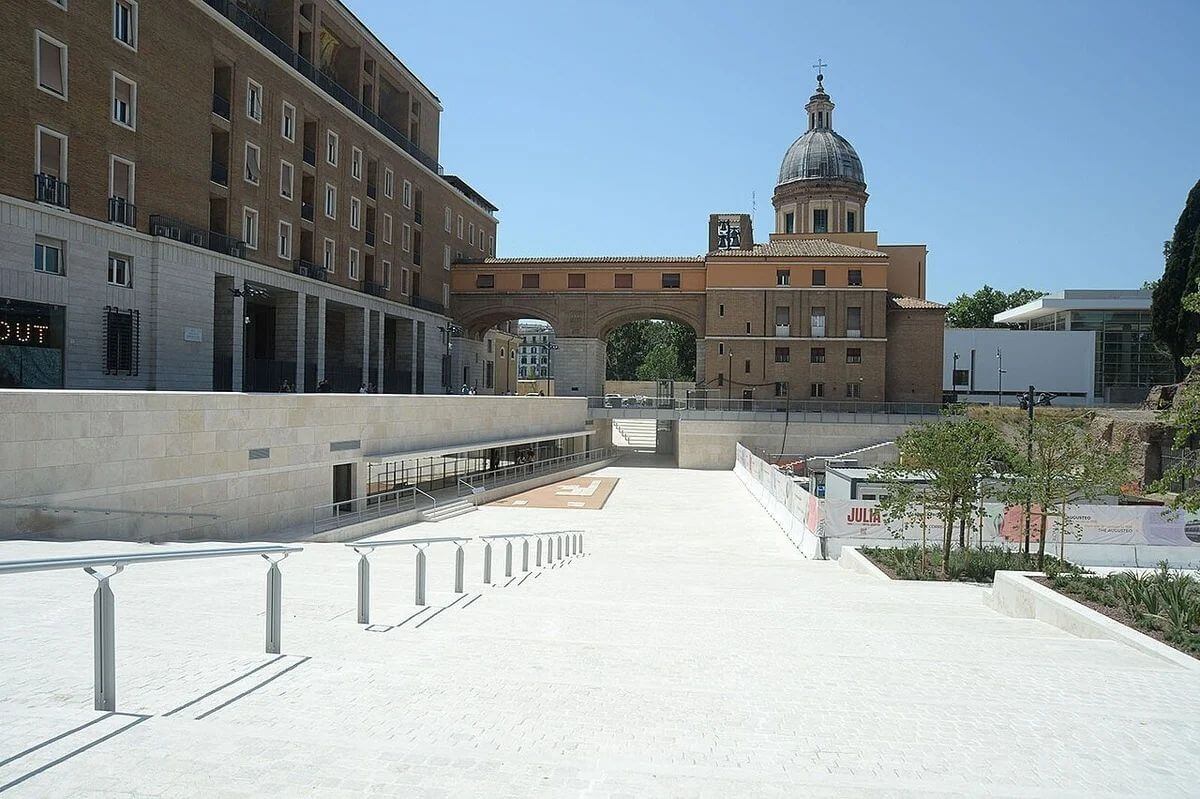
From the piazza, the mausoleum’s curving outer wall gives a clear sense of its circular plan. Its south-facing doorway marks the ancient entrance, while the surrounding streets sit above the tomb’s original ground level.
The redesigned piazza, opened in June 2025, brings you down toward that ancient level along two broad stepped approaches. One connects with Via di Ripetta, the other with the area behind San Carlo al Corso. Moving between the street and the lower square makes the difference between modern Rome and the ancient city easier to grasp.
The Res Gestae Beside the Ara Pacis
On the side of the Ara Pacis Museum facing the mausoleum, a long Latin inscription runs across an exterior wall. Its bronze letters reproduce the Res Gestae Divi Augusti, or “The Deeds of the Divine Augustus.” The wall dates to 1938 and was preserved when the present museum replaced the earlier pavilion.
The text presents Augustus through his own account of his achievements: the offices he held, his military successes, the money he distributed, and the buildings he financed. The original was displayed on bronze tablets near the mausoleum’s entrance. Here, its modern reproduction connects the emperor’s family tomb with the public image he wanted to leave behind.
Who Was Buried in the Mausoleum of Augustus?
Augustus was cremated, and his ashes were placed in the mausoleum after his death in AD 14. The tomb served several generations of the imperial family, with burials beginning decades before the emperor’s own.
The first person buried here was Marcellus, Augustus’s nephew and son-in-law, who died in 23 BC. Other notable burials included:
- Marcus Agrippa: Augustus’s general and son-in-law, who married his daughter Julia after Marcellus’s death.
- Octavia: Augustus’s sister and the mother of Marcellus.
- Gaius and Lucius Caesar: Augustus’s grandsons, whom he adopted as sons and prepared to succeed him. Both died before him.
- Livia: Augustus’s wife and the mother of the emperor Tiberius.
- Tiberius, Claudius, and Nerva: Later emperors whose remains were also placed in the mausoleum.
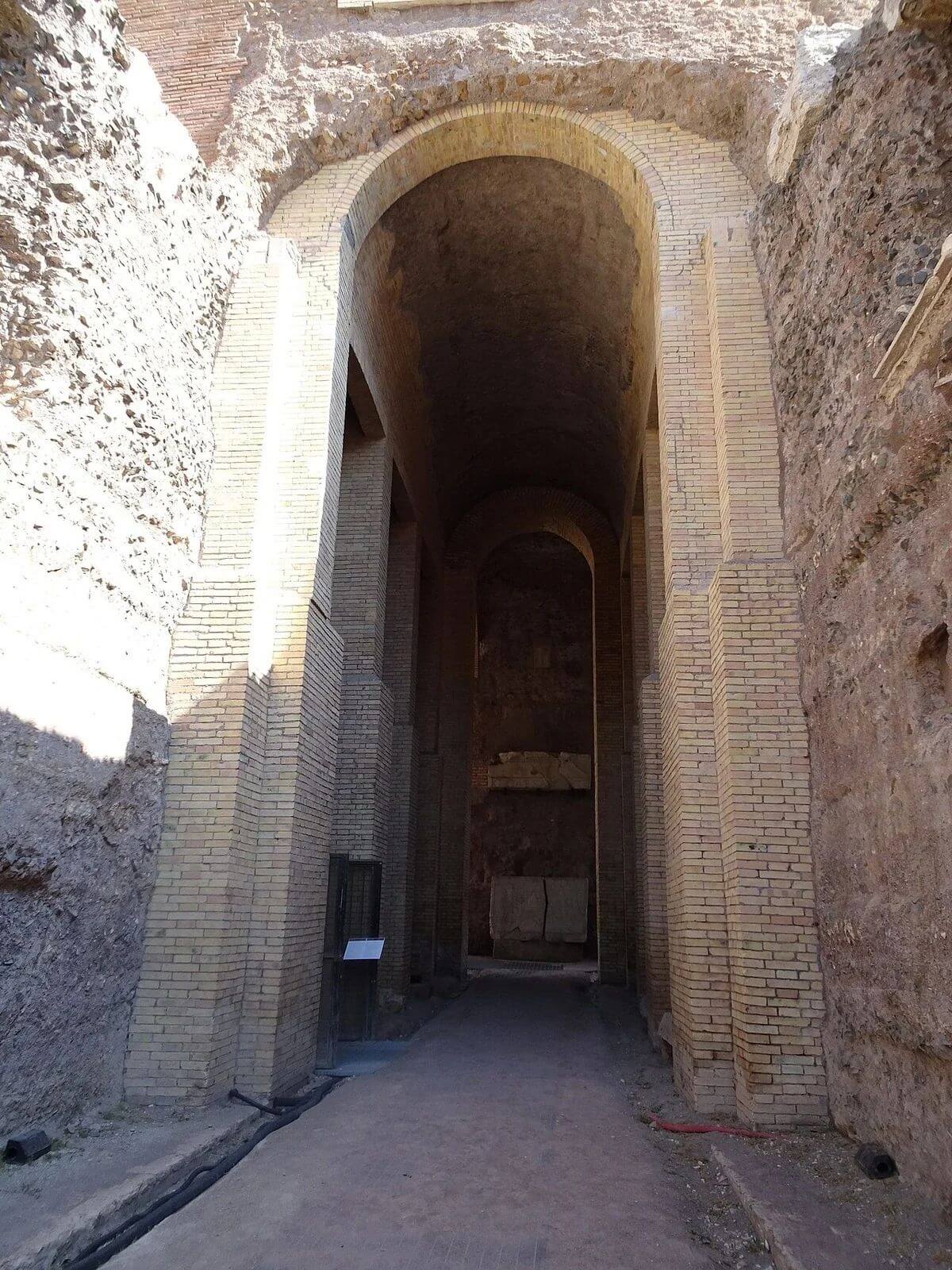
 Inside, funerary urns occupied niches in the circular burial chamber. Augustus’s own ashes may have been placed in a separate chamber within the central core.

What Did Augustus’s Tomb Originally Look Like?
The Mausoleum of Augustus once rose as a tree-covered mound above a monumental circular base, crowned by a gilded bronze statue of the emperor. Its exterior was faced with pale travertine blocks, giving it a very different appearance from the exposed masonry of today’s ruins.
Construction is traditionally dated to 28 BC, although architectural studies suggest that work may have begun earlier. The base measured about 285 feet (87 meters) across. Within it, concentric walls formed rings around the heart of the tomb, while a long entrance corridor, the dromos, led inward to the burial chamber.
Modern reconstructions show a higher cylindrical structure rising above the base, with the emperor’s statue at the summit. The ancient description by Strabo also places a wooded area with walks behind the mausoleum.
In front stood two granite obelisks, both later moved elsewhere in Rome:
- Piazza dell’Esquilino: One now rises behind the Basilica of Santa Maria Maggiore.
- Piazza del Quirinale: The other forms part of the Dioscuri Fountain, where it stands between the colossal statues of Castor and Pollux.
From Imperial Tomb to Fortress, Garden, and Concert Hall
During the Middle Ages, the Colonna family built a fortress on the mausoleum’s massive remains. After the fortress was destroyed in 1241, stone from the monument was stripped away, reused in other buildings, or burned to make lime.
In the 16th century, the Soderini family created an Italian Renaissance garden in the upper part of the ruins, decorated with ancient sculptures. The garden sat above collapsed and buried structures. With the original southern entrance underground, a new entrance opened to the north, beside the family’s palace.
The garden later gave way to public entertainment. Under the Correa family, an amphitheater was laid out within the monument, hosting bull and buffalo hunts from 1780. The venue became known as the Correa amphitheater and later hosted theatrical performances; a glass dome eventually covered the arena.
In 1908, another audience arrived: concertgoers. The building had become the Auditorium Augusteo, where the Accademia Nazionale di Santa Cecilia performed until 1936.
The concert hall closed as Mussolini’s Fascist regime began removing the dome and later structures above the tomb. The surrounding historic neighborhood was also demolished to create Piazza Augusto Imperatore, designed by Vittorio Ballio Morpurgo. These 1930s clearances explain why the mausoleum now stands apart from the buildings around it, at the center of an open square.

How to Get to the Mausoleum of Augustus?
Address: Piazza Augusto Imperatore, Rome, Italy.
The Mausoleum of Augustus is in Campo Marzio, just west of Via del Corso and opposite the Ara Pacis Museum. For map searches, use its Italian name, Mausoleo di Augusto.
Spagna and Flaminio–Piazza del Popolo are both on Metro Line A. From either station, continue on foot:
- From Spagna: Walk through Piazza di Spagna, then take Via dei Condotti to Via del Corso. Cross Via del Corso and take Via Tomacelli, which leads to Via di Ripetta and the southern side of the piazza.
- From Flaminio–Piazza del Popolo: Walk through Porta del Popolo into Piazza del Popolo, then follow Via di Ripetta south toward the Ara Pacis Museum. The mausoleum is on the opposite side of the street.
What to See Near the Mausoleum of Augustus?
- Ara Pacis Museum: Just across Via di Ripetta, the museum houses the Ara Pacis, or Altar of Augustan Peace. Its carved processions and scrolling acanthus leaves bring the art of Augustus’s reign into focus. This is the closest continuation if you want to explore the emperor’s Rome through sculpture.
- Piazza di Spagna: The Spanish Steps rise toward Trinità dei Monti, while the boat-shaped Barcaccia Fountain sits at their foot. Combine the square’s Baroque architecture with the boutiques along Via dei Condotti for a walk through a different period of Rome’s history.
- Villa Medici: Near the top of the Spanish Steps, this Renaissance villa offers guided visits to its historic gardens and painted rooms. The garden facade incorporates ancient reliefs, bringing Roman sculpture into a Renaissance setting.
- Pincio Terrace: Above Piazza del Popolo, the terrace opens onto Rome’s rooftops and St. Peter’s dome. The uphill walk adds a panoramic stop to the outing, with the promenade continuing toward Villa Borghese.
- Piazza del Popolo: An Egyptian obelisk marks the center of this broad square, with the twin churches on its southern side. At the foot of the obelisk, marble lions spout water into round basins.

Fanny, a skilled writer with a keen interest in art and culture, has been enchanted by the Borghese Gallery’s exquisite collection and its history. As a significant contributor to the Visit Borghese Gallery blog, she artfully shares insights and stories, bringing the gallery’s masterpieces and the lush gardens to life for readers around the world.