
- On November 19, 2026
- In PLAN YOUR VISIT Top attractions
Quirinal Palace in Rome: What to See and How to Visit
Once home to popes and kings, the Quirinal Palace (Palazzo del Quirinale) is now the seat of Italy’s presidency. Its ceremonial rooms still play a part in state occasions, while contemporary Italian art and design share space with historic decoration.
With several guided routes and access shaped by the palace’s official activities, a visit takes a little planning. This guide will help you choose a tour that suits your interests, arrange your reservation, and organize your visit, including what to see in Piazza del Quirinale.
Quirinal Palace Key Facts
- Location: Quirinal Hill in central Rome, outside Villa Borghese.
- Visit options: Three guided routes covering the historic rooms, gardens and collections, or contemporary art and design.
- Reservations: Required for palace tours. Tickets are issued in each visitor’s name.
- Language: Tours are conducted in Italian.
- Duration: About 1 hour and 20 minutes per route.
- Cost: Tours are free, with a mandatory €2.50 reservation fee per person.
What to See at the Quirinal Palace?
The spaces you see depend on your chosen route, and official activities can affect access to individual rooms.
State Rooms and Imperial Apartments
In the Salone dei Corazzieri, the colored marble floor echoes the geometric pattern of the carved wooden ceiling overhead. High on the walls, a painted frieze shows eight diplomatic missions received during the papacy of Paul V, including the Japanese envoy Hasekura Tsunenaga. These scenes recall the rulers and ambassadors the pope welcomed into the hall.
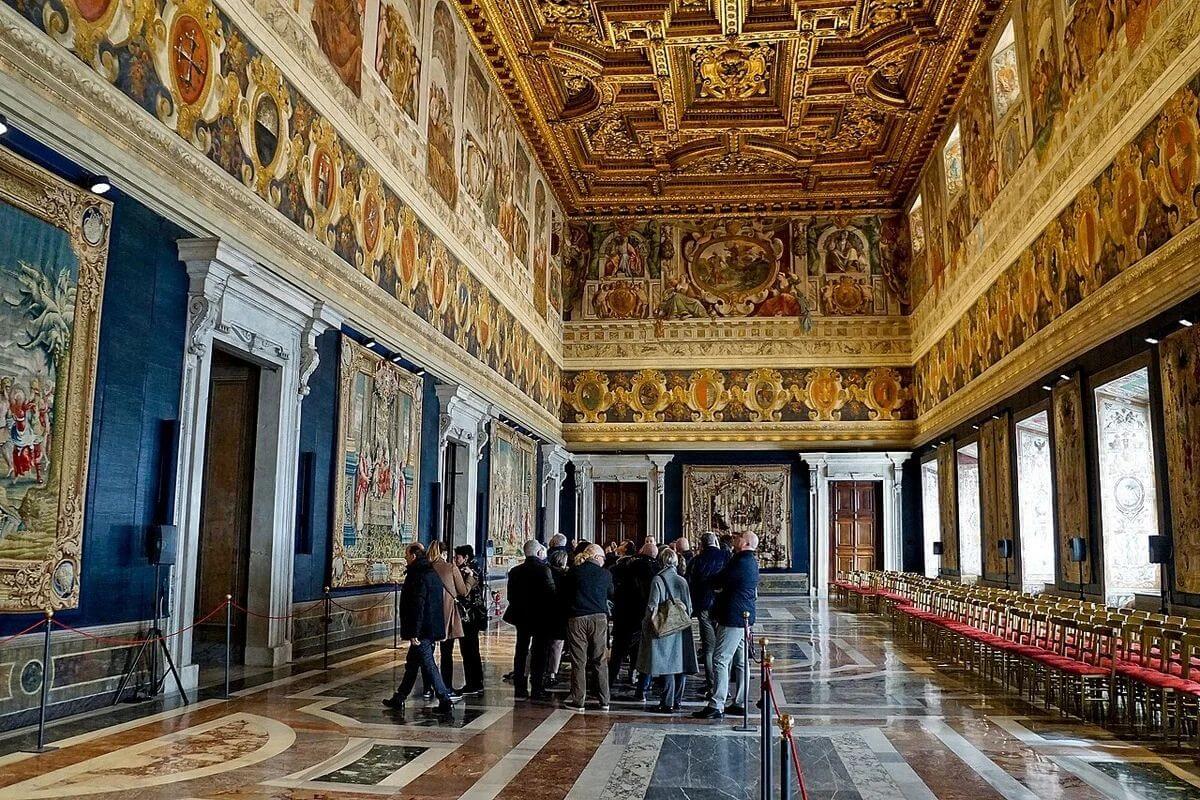
The Cappella Paolina has a seventeenth-century ceiling covered in white and gold stucco. Its dimensions match those of the Sistine Chapel, allowing papal ceremonies to be held at either the Vatican or the Quirinal.
The Imperial Apartments include the Japanese Parlour, where lacquer panels show rivers, pavilions, and boats against glossy black backgrounds. Despite the room’s name, the panels are Chinese and came from the Savoy residences in Turin. The apartments’ imperial name recalls visits by Germany’s Emperor Wilhelm II in 1888 and 1893.
Gardens, Porcelain and Carriages
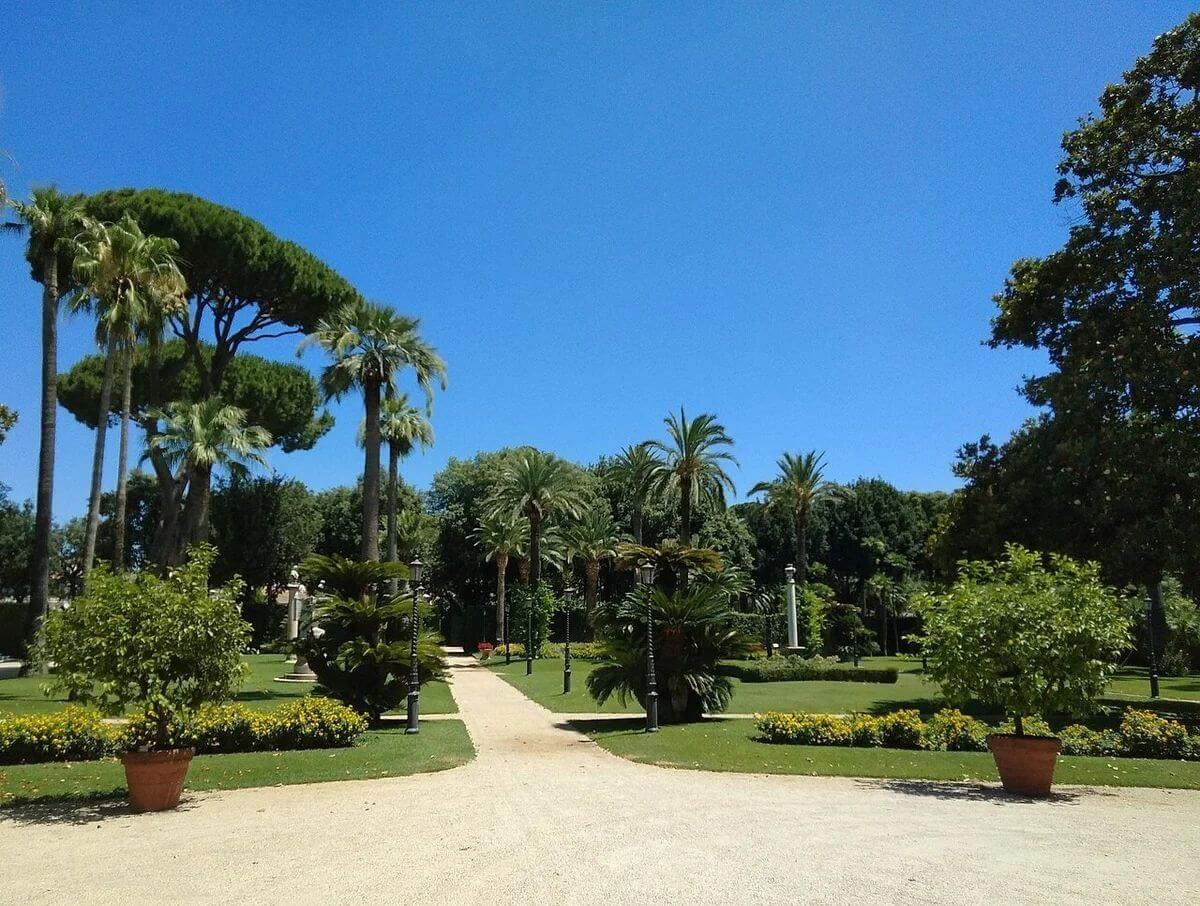
Along Viale delle Palme, geometric flowerbeds line the avenue through the palace gardens. These grounds were also used for entertaining: popes received ambassadors outdoors as well as in the rooms inside.
The Vasella, where the palace’s porcelain tableware is kept, includes services from Meissen and Sèvres. Among the Sèvres pieces, painted birds appear against sky-blue backgrounds, while floral designs stand out on green. Many table services came to the palace from the courts of pre-unification Italy.
The carriage collection ranges from elaborate gala coaches to vehicles for more practical journeys. On one nineteenth-century coach, painted scenes follow Telemachus’s search for his father, Odysseus, turning the vehicle’s body into a sequence of stories.
These spaces are visited on the dedicated gardens, porcelain, and carriages route. The gardens are not a public park you can enter directly from the square.
Quirinale Contemporaneo: Art and Design
Quirinale Contemporaneo brings modern and contemporary art and Italian design into the palace’s historic rooms. In the Prima Sala di Rappresentanza, Lucio Fontana’s Concetto spaziale, Venice Moon has actual cuts in its canvas, making the surface itself part of the work.
In the Sala della Vittoria, Architettura, the cabinet designed by Piero Fornasetti and Gio Ponti, looks like a building in miniature. Black-and-white facades, windows, and stairways drawn in perspective create the illusion of depth across its surfaces.
Quirinal Palace Tickets and Guided Tours
A palace reservation gives you a place on one of three official guided routes.
Which Guided Tour Should You Book?
- Percorso Artistico-Istituzionale: The Courtyard of Honor and historic interiors, including the ground floor, main ceremonial floor (Piano Nobile), and Imperial Apartments.
- Itinerario tematico – Vasella, Giardini e Carrozze: The gardens, porcelain, and carriages, for a visit focused on the grounds and royal collections.
- Quirinale Contemporaneo: Modern and contemporary art and Italian design in the same historic areas as the artistic-institutional route.
All three tours are conducted in Italian and last about 1 h 20. Palace visits include exhibitions only when they are within the tour route.
Reservation Fees and How to Book
The tours are free, with a mandatory €2.50 reservation fee per person for any of the three routes.
- Online: Use the official booking system to choose your route and an available date and time.
- By phone: Call +39 06 42012191, daily from 9 a.m. to 5 p.m., Rome time.
- In person: Make a reservation at the infopoint, Salita di Montecavallo 15, open Tuesday, Wednesday, Friday, Saturday, and Sunday, 9 a.m.–5 p.m.
Pay by credit card online or by phone. The infopoint also accepts debit cards and cash.
Tickets are issued in each visitor’s name for a fixed date and time. Under the official booking conditions, reservations normally cannot be changed or refunded.
 If official events or bad weather change or shorten the route, no full or partial refund is offered. If the palace cancels your visit because of official commitments, you can reschedule or receive a refund.

Practical Information for Your Visit
Opening Hours and Closures
- Visiting days: Tuesday, Wednesday, Friday, Saturday, and Sunday.
- Hours: 9:30 a.m.–4 p.m., with last admission at 2:30 p.m.
- Regular closures: Mondays and Thursdays.
Plan around your booked time, as departures vary by route. Official commitments can also affect the palace’s visiting calendar.
Location and How to Get There
Visitor entrance: Via del Quirinale, at the intersection with Via della Consulta, 00187 Rome, Italy.
The entrance is along the side of the palace. Head here for your tour, rather than to the main portal facing the square or the reservation infopoint.
- From Trevi Fountain: The approach via Via della Dataria includes a climb and steps up to Piazza del Quirinale. Continue along Via del Quirinale to the visitor entrance.
- By metro: Repubblica on Line A and Cavour on Line B are options for reaching the area; both require a walk to the palace.
GOOGLE MAP
Arrival, Security Checks and Dress Code
Arrive 15 minutes before your tour for security checks. Late arrivals are not admitted.
- Identification: Bring a valid identity document matching the name on your reservation.
- Dress code: Appropriate attire is required.
- Children: Visitors under 12 must be accompanied by an adult.
- Bags and objects: Suitcases, rolling luggage, duffel bags, backpacks, plastic or glass bottles, cans, umbrellas, sharp or pointed objects, and blunt instruments are not allowed.
- Photography: Photos and video are prohibited during the visit.
- Conduct: Follow the marked route and leave artworks and furnishings untouched. Smoking, vaping, and using amplification equipment or radio transmitters are prohibited.
- Animals: Animals are not admitted, except guide dogs for blind visitors.
Accessibility
When booking, discuss your chosen route and accessibility needs with the official reservation service, so staff can arrange suitable assistance.
- Inside the palace: Elevators and other means of assistance are available along the tour route.
- Gardens: Gravel paths can make moving around difficult for wheelchair users and visitors with strollers.
- Visual impairments: There is currently no tactile route for blind or partially sighted visitors.

What to See in Piazza del Quirinale?
The Dioscuri Fountain and the Obelisk
The two colossal figures beside the obelisk are Castor and Pollux, the mythological twins known as the Dioscuri. Each holds a horse by the reins, and the figures stand more than five meters tall. This is the Dioscuri Fountain, also called the Fountain of Monte Cavallo.
The statues probably came from the Temple of Serapis before being reused at the Baths of Constantine on the Quirinal Hill. The obelisk between them came from the Mausoleum of Augustus, while the broad granite basin below was brought from the Roman Forum and installed here in 1818. What looks like a single monument brings together pieces with very different histories.
The Palace Facade and the Loggia delle Benedizioni
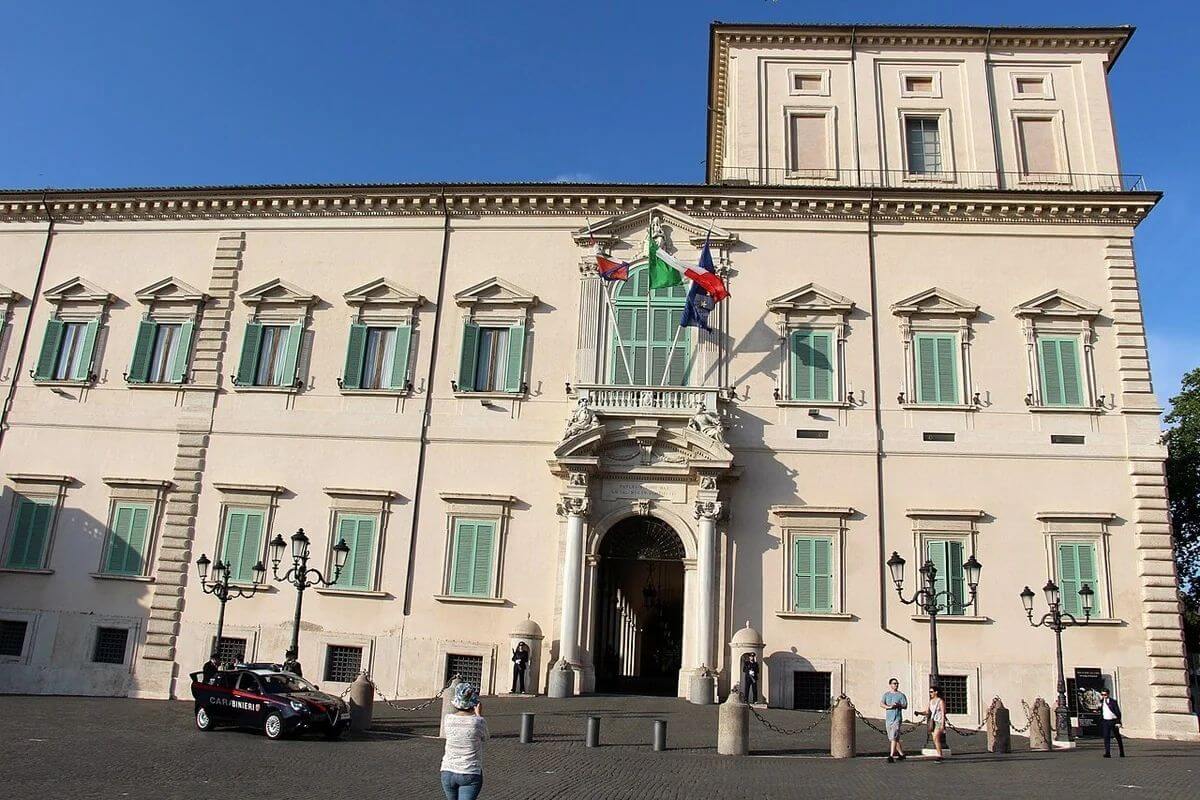
On the palace facade, the main portal gives you a starting point: directly above it is the Loggia delle Benedizioni, recognizable by its stone balustrade and triangular pediment. Gian Lorenzo Bernini designed it in 1638. Its name means “Loggia of Blessings”: popes used this balcony to bless the people gathered in the square.
The more ornate Palazzo della Consulta also faces the square. Its sculpted facade belongs to a separate building, now home to Italy’s Constitutional Court.
For the ceremonial changing of the guard, which can include a military-band performance, plan around a date announced in the presidency’s official notices. Seeing guards on duty does not mean that a formal ceremony is taking place.
How Popes, Kings and Presidents Shaped the Palace
Built in 1583–1585 for Pope Gregory XIII, Ottaviano Mascarino’s villa was soon too small for the papal court. Successive popes enlarged it into a palace for worship, audiences, and diplomatic reception.
Under Paul V Borghese, two architects shaped the palace’s ceremonial spaces:
- Flaminio Ponzio built the grand staircase.
- Carlo Maderno created the Cappella Paolina and the hall now called the Salone dei Corazzieri.
The Sala Gialla, Sala di Augusto, and Sala degli Ambasciatori were once a single long gallery decorated for Pope Alexander VII. In 1812, the French administration divided it into three rooms while preparing the palace for Napoleon, who never stayed here. Much of the earlier painting was covered over; the palace’s restoration of the gallery has brought those seventeenth-century frescoes back into view.
When the House of Savoy took over in 1870, the papal palace was refitted for Italy’s royal court. Rooms in the garden wing acquired Louis XV–style decoration, while furniture, paintings, and tapestries arrived from royal residences across Italy.
The 1946 referendum ended the monarchy, and the Quirinal became the official seat of Italy’s presidency in 1948. The republican administration has focused on conserving the rooms and collections inherited from earlier centuries. Today, these historic spaces remain part of a working presidential residence, used for meetings with state representatives and other official engagements.
What to See Near the Quirinal Palace?
- Scuderie del Quirinale: The temporary exhibitions in these former papal stables let you continue exploring art just across the square.
- Sant’Andrea al Quirinale: A chance to discover Bernini’s architecture in a church, where marble, sculpture, and gilding come together in one richly decorated interior.
- Trevi Fountain: For an outdoor stop after the palace interiors, Trevi brings together a grand architectural backdrop, flowing water, and monumental sculpture.
- Piazza di Spagna: A longer walk through the center brings you to the Spanish Steps and Barcaccia Fountain, with the streets around the square offering a natural continuation for browsing and strolling.
- Porta Pia: Michelangelo’s monumental gate connects the palace visit with the story of Rome’s transition from papal rule to the Kingdom of Italy. It suits a longer walk with a historical focus.
- Borghese Gallery: For a longer outing, continue exploring Rome’s art with Bernini’s sculptures and Caravaggio’s paintings in a villa surrounded by the gardens of Villa Borghese.

Fanny, a skilled writer with a keen interest in art and culture, has been enchanted by the Borghese Gallery’s exquisite collection and its history. As a significant contributor to the Visit Borghese Gallery blog, she artfully shares insights and stories, bringing the gallery’s masterpieces and the lush gardens to life for readers around the world.