

- On July 24, 2019
- In PLAN YOUR VISIT Top attractions Villa Medicis
Villa Medici in Rome: Gardens, Guided Tours and What to See
Behind the walls near the Spanish Steps, Villa Medici in Rome opens onto formal gardens and a facade studded with ancient reliefs. You’ll need a guided tour to visit the historic grounds and the cardinal’s painted rooms, with views across the city along the way.
Home to the French Academy in Rome, this Renaissance villa also welcomes artists and researchers in residence. You can explore the exhibition galleries on your own with an exhibition-only ticket.
Villa Medici: Key Facts
- Location: Viale della Trinità dei Monti 1, on the Pincio Hill near the Spanish Steps. The nearest metro stop is Spagna, on line A.
- Guided tour: About 90 minutes, covering the historic gardens and apartments. Temporary exhibitions are included in the tour ticket.
- Tour prices: €18 full price; €15 reduced, including visitors under 25. Admission is free for visitors under 18. Bring proof of eligibility for a reduced or free ticket.
- Opening hours: 9:30 a.m.–7 p.m., with last admission at 6:30 p.m. Closed Tuesdays and December 25. Guided tours have separate departure times.
- Accessibility: The historic apartments are not accessible to visitors with reduced mobility; garden access for these visitors involves a long, steep ramp.
Villa Medici Tickets and Guided Tours
Choose your ticket according to what you want to see:
- Guided-visit ticket: Access to the historic gardens and apartments, with temporary exhibitions included (check availability on this page).
- Exhibition-only ticket: Explore the exhibition galleries on your own. This ticket does not include the historic gardens or apartments.
What the Guided Tour Includes
The tour includes Cardinal Ferdinando de’ Medici’s apartments and the Bird Room, a small room painted with birds and other animals. You’ll also see the garden facade and look out over Rome.
Some exhibition displays in the historic rooms may only be accessible on the guided tour. Other parts of the estate remain reserved for the villa’s residents.
Allow about 90 minutes. Tours are offered in English, French, Italian and Spanish, with departure times varying by language.
Prices, Free Admission and Booking
- Full-price tour: €18 per person.
- Reduced-price tour: €15 for eligible visitors, including those ages 18–24, jobseekers, and fellows or members of foreign academies in Rome.
- Free admission: Visitors under 18, visitors with disabilities and their companion, journalists, and ICOM or ICOMOS cardholders are among those eligible.
Exhibition-only tickets are priced separately. The current exhibition listings give the admission price and ticket options for each show. Villa Medici does not offer general free admission on the first Sunday of the month.
Buy either type of ticket through the official ticket office or on site, subject to availability. Guided-tour tickets usually go on sale about a month ahead. Choose your date, time and language when booking, and book ahead if you want a particular departure.
For a same-day tour, you can buy tickets up to 30 minutes before departure online or 5 minutes before departure on site, if places remain. You can show your ticket on your phone.

What to See at Villa Medici?
The Garden Facade and Loggia
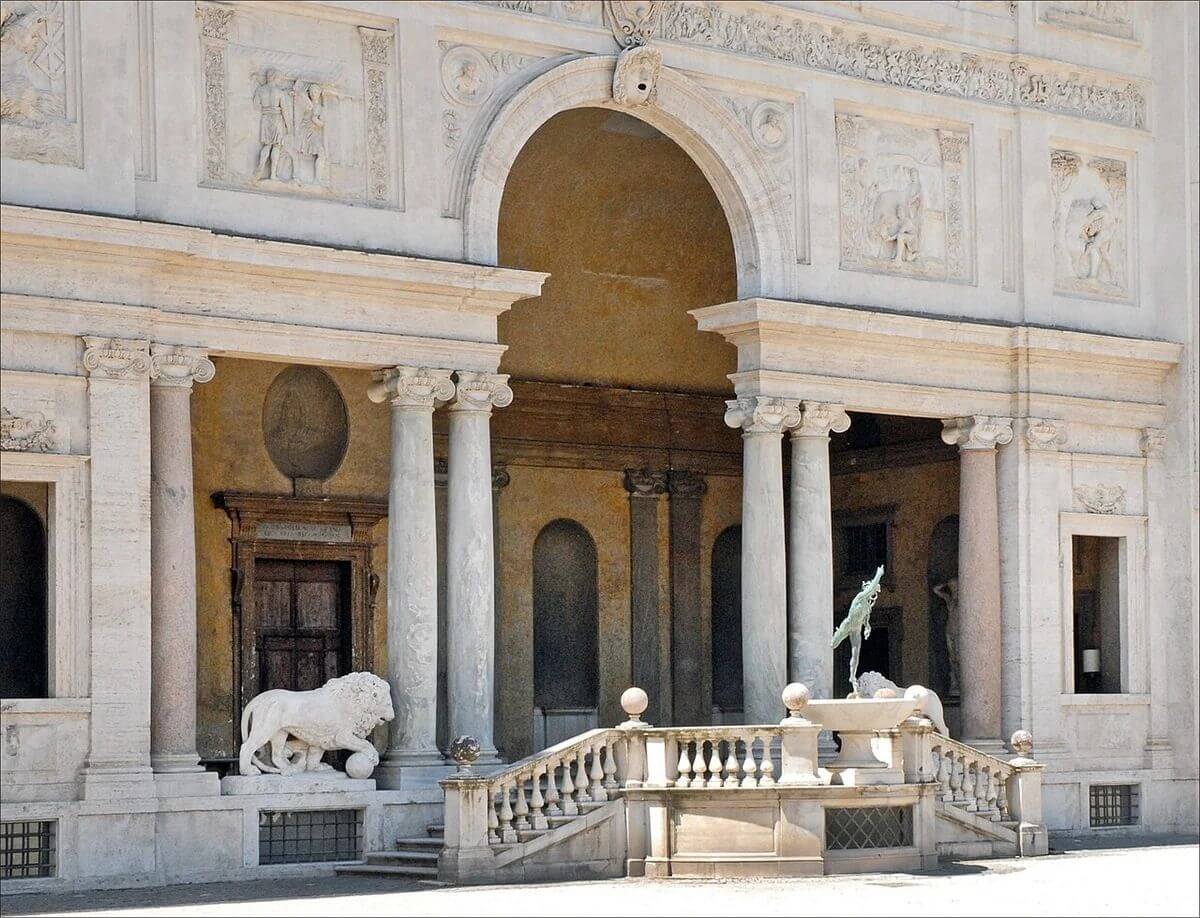
From the garden, look back at the villa’s two towers and richly decorated facade. Ancient reliefs are set into the walls between the windows, turning the building itself into a display of sculpture. Ferdinando de’ Medici used this setting to show his collection of antiquities.
At the center, the loggia forms a sheltered space open to the garden. Look for the large round arch flanked by two smaller openings with straight tops: this three-part arrangement is called a Serlian opening. Paired columns frame the bays, while sculpted masks and reliefs fill the stonework above.
The Historic Gardens and Views over Rome
Low hedges divide the formal garden into geometric plots, with straight paths drawing your eye toward statues and fountains. The guided visit gives access to the piazzale, the broad forecourt facing the villa, and the adjoining garden plots. The full seven-hectare estate also contains areas reserved for residents.
The belvedere, a viewpoint overlooking Rome, opens the scene out beyond the garden walls. Pause here to take in the city’s rooftops and domes.
In the Niobid group, Niobe tries to shield her youngest daughter. Apollo and Artemis are attacking her children to punish her boast that she is a better mother than Leto, their own mother. The garden statues are copies of the ancient group taken from Rome to the Uffizi in Florence. Restoration work may limit your view; see the villa’s restoration notice.

The Historic Apartments and the Bird Room
In the cardinal’s apartments, look up at the painted ceiling panels, then at the friezes, the bands of decoration high on the walls. The Elements Room has the marriage of Jupiter and Juno painted overhead. Jacopo Zucchi and his workshop created these decorations around 1584–1585.
The Bird Room belongs to a separate studiolo, a small retreat at the far end of the gardens above the Aurelian Walls. Its frescoes, painted in 1576–1577, turn the interior into a garden of its own: birds and other animals appear among the plants of a painted arbor. Take a moment to pick out individual creatures among the leaves.

Opening Hours and Practical Tips
Opening Days and Tour Times
- Site hours: 9:30 a.m.–7 p.m., with last admission at 6:30 p.m.
- Closed days: Tuesdays and December 25. The villa is open on other public holidays.
- Galleries and services: The ticket office and bookshop close at 6:30 p.m. Plan to finish the galleries by then.
Guided tours have set departure times that vary by language and day. Choose the slot shown for your visit in the official tour calendar.
Exhibition hours can differ from the site’s general hours. For an exhibition-only visit, check both opening and closing times on your chosen show’s exhibition listing.
Accessibility, Bags and Facilities
Much of the tour is outdoors; bring water and sun or rain protection.
- Mobility access: A steep 96-meter ramp (about 315 feet, with an 11.5% grade) leads to the gardens. The historic apartments and cinema are inaccessible to visitors with limited mobility.
- Exhibition access: Three of eight exhibition rooms are accessible to visitors with limited mobility. There are no public elevators.
- Bags and strollers: Small bags are allowed. Large bags, suitcases and strollers are not permitted, and there is no coat check or storage. Bring a baby carrier instead of a stroller.
- Food and drink: There is no public café or restaurant.
- Other restrictions: Pets and motorcycle or bicycle helmets are not permitted.
How to Get to Villa Medici?
Use the street entrance at Viale della Trinità dei Monti 1, on the Pincio near the top of the Spanish Steps.
- By bus: Minibus 119 stops at Trinità dei Monti.
- By taxi: Ask for Villa Medici on Viale della Trinità dei Monti.
- Parking: The villa has no visitor parking. Parking Ludovisi, Via Ludovisi 60, is a paid public garage about 750 meters (0.5 miles) from the entrance.
From Spagna and the Spanish Steps
Take Metro Line A to Spagna. From the station, you can approach the villa in two ways:
- Via the Spanish Steps: Climb the Spanish Steps to Trinità dei Monti, then follow Viale della Trinità dei Monti toward Villa Medici.
- Via San Sebastianello: Walk uphill along Via di San Sebastianello and continue to the entrance on Viale della Trinità dei Monti.
From the Pincio and Villa Borghese
From Pincio Terrace, follow the public promenade toward Trinità dei Monti and the Spanish Steps, continuing to Villa Medici’s entrance on Viale della Trinità dei Monti.
If you are walking through Villa Borghese, head toward the Pincio and join that approach. Villa Medici occupies its own enclosed grounds beside the public park; enter from the street at the address above.

From a Medici Villa to the French Academy in Rome
In ancient Rome, this part of the Pincio lay within the gardens of Lucullus. The villa you visit today took shape much later. Cardinal Giovanni Ricci bought the property in 1564 and began expanding its buildings and gardens.
When Ferdinando de’ Medici acquired the estate in 1576, he brought in architect Bartolomeo Ammannati to enlarge the residence and create a setting for his collection of ancient sculpture. The loggia, second tower and garden facade decorated with ancient reliefs belong to this transformation.
A new purpose arrived in 1803, when the French Academy in Rome moved here. Founded under Louis XIV in 1666, the Academy sent young French artists to Rome to study ancient and Renaissance art. The cardinal’s residence became their home and workplace.
Later artists also left their mark on the interiors. As director from 1961 to 1977, the painter Balthus oversaw the restoration of Renaissance frescoes and developed softly colored wall finishes. Their layered surfaces sit alongside the older painted friezes in some of the historic rooms.
Today, artists, writers, composers and researchers still live and work at Villa Medici. Its exhibitions and events bring contemporary work into the galleries, gardens and historic spaces. Look through the program when planning your visit: alongside exhibitions, it includes concerts, film screenings and festivals, each with its own dates and admission arrangements.

What to See near Villa Medici?
- Pincio Terrace: Continue along the public promenade for a view over Piazza del Popolo, its central obelisk and twin churches. St. Peter’s dome rises beyond the rooftops. The terrace is also a popular place to watch the sunset.
- Spanish Steps and Trinità dei Monti: Walk toward the church at the top of the steps, then descend to Piazza di Spagna. At the foot of the staircase, look for the Barcaccia, Pietro Bernini’s fountain shaped like a half-sunken boat. This route brings you back down into the streets of the historic center.
- Villa Borghese Gardens: For a longer walk, continue beyond the Pincio into the public park. Head toward the lake and Temple of Asclepius if you have time to explore further. The small temple stands on an island, with paths around the water and trees framing the view.
- Borghese Gallery: Continue farther into Villa Borghese for Bernini’s marble sculptures and paintings by Caravaggio. The museum requires a separate timed-entry reservation, so plan it around your Villa Medici booking.
- Piazza del Popolo: Descend from the Pincio to explore the square at street level. Around the Egyptian obelisk, look for the lion fountains, with water spouting from the animals’ mouths into round basins. Via del Corso leads from the square into the historic center.
- Capuchin Museum and Crypt: For an indoor visit, head toward Piazza Barberini and Via Veneto. Beneath the church of Santa Maria della Concezione, human bones and skulls form patterns across the crypt’s walls and ceilings, expressing the friars’ beliefs about death and resurrection.

Fanny, a skilled writer with a keen interest in art and culture, has been enchanted by the Borghese Gallery’s exquisite collection and its history. As a significant contributor to the Visit Borghese Gallery blog, she artfully shares insights and stories, bringing the gallery’s masterpieces and the lush gardens to life for readers around the world.
I would like to buy 3 tickets online for Villa Medici for 15.04.2023 at 15.00
ask for assistance
Hi,
Sure, how can I help you ?
We are trying to book tickets to Villa Medici for either Friday 31st March or Saturday 1st April and can’t find how to do it. Can you help please?
Hi,
Sure, how can I help you ?