
- On October 30, 2026
- In ABOUT VILLA BORGHESE Art collections Uncategorized
Aeneas, Anchises and Ascanius: Bernini’s Flight from Troy
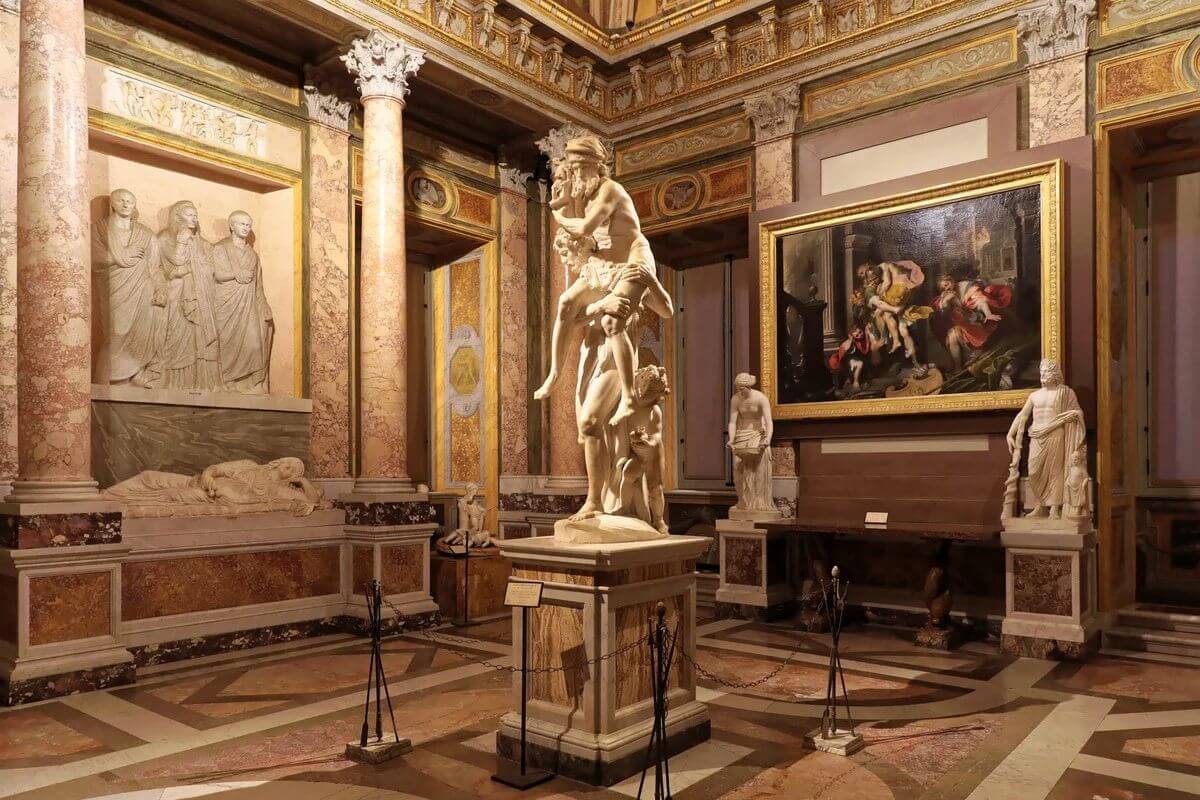
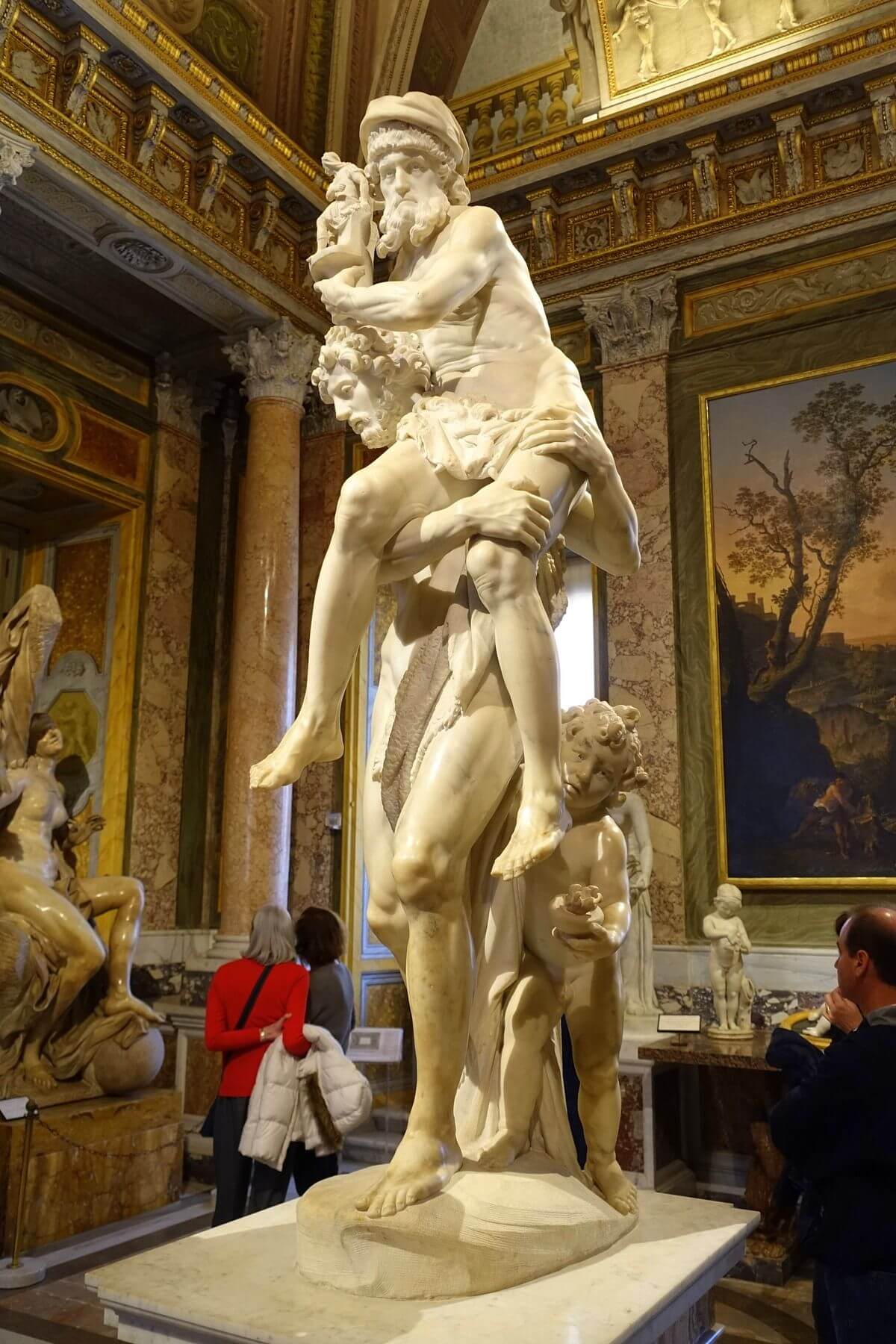
An old man sits high on his son’s shoulder, while a small boy follows behind their legs. In Aeneas, Anchises and Ascanius, Gian Lorenzo Bernini brings three generations together in a single marble group: Aeneas carries his father, Anchises, out of burning Troy, with his son Ascanius close behind.
Made for Cardinal Scipione Borghese and dated 1619 in the museum’s collection catalog, the sculpture stands in Room 6 of the Borghese Gallery in Rome. Its story is one of escape, but the figures also show what the family refuses to leave behind: an elderly parent, a child, and the gods of their home.
Aeneas, Anchises and Ascanius: Key Facts
- Artist: Gian Lorenzo Bernini (1598–1680).
- Italian title: Enea, Anchise e Ascanio.
- Date: 1619 in the museum’s object record; often dated 1618–1619.
- Material: Marble.
- Height: 220 cm, about 87 inches.
- Patron: Cardinal Scipione Borghese.
- Subject: Aeneas rescuing his father Anchises, accompanied by his son Ascanius, during the fall of Troy.
- Location: Room 6, the Aeneas and Anchises Room, ground floor, Borghese Gallery, Rome.
Who Are Aeneas, Anchises and Ascanius?
Aeneas is the adult carrying the weight of the group. Anchises is his elderly father; Ascanius is his young son. The episode comes from Book II of Virgil’s Aeneid, as Greek forces destroy Troy. Aeneas has fought to defend the city, but now he must get his family out.
He tells Anchises to climb onto his shoulders and asks him to carry their sacred objects and household gods, the Penates. Aeneas has been fighting and considers his bloodstained hands unfit to touch them until he has purified himself. His son, also called Iulus, takes his hand, while his wife Creusa follows at a distance.
Creusa is lost during the escape. Aeneas goes back to search for her, but her ghost tells him that his journey must continue. Bernini leaves her out of the sculpture, concentrating the scene on the father, son, and grandson.
The journey eventually takes Aeneas to Italy. He is a legendary ancestor of the Romans, rather than the founder of Rome itself; that role belongs to Romulus in Roman tradition.
Reading Bernini’s Marble: Weight, Skin, and Movement
How Aeneas Supports Anchises
Anchises sits on one of Aeneas’s shoulders rather than lying across his back. One leg hangs down in front of the younger man’s chest, while Aeneas holds the other with both hands. Their limbs overlap so closely that it takes a moment to separate the two bodies.
Then look down to Aeneas’s feet as he steps forward.
In Bernini’s later Apollo and Daphne, the lifted arms and branches extend the action outward; here, the bodies stay gathered around the task of carrying Anchises.
The Three Ages of Life
The different bodies also give Bernini three ways to carve skin. Ascanius has rounded cheeks and soft limbs; Aeneas has a broad chest and clearly defined muscles; Anchises has a thinner body, with loose skin and prominent veins.
Look especially at the contrast between Anchises’s chest and Aeneas’s torso. The older man’s skin hangs more loosely over his ribs, while the younger man’s muscles swell beneath a taut surface.
The museum identifies this as the traditional theme of the three ages of man.
 Compare the skin here with The Rape of Proserpina, where Pluto’s fingers seem to press into soft flesh.
What Does the Sculpture Mean?
The rescue gives visible form to pietas, the Roman ideal of fulfilling obligations to family, gods, and community. Aeneas carries his father while Anchises preserves the household gods.
The small sacred figures held by Anchises can be easy to miss above Aeneas’s head. Ascanius carries a flame, identified by the museum as the sacred fire of Vesta. The flame is a feature of Bernini’s representation; Virgil’s escape passage instead describes the child holding his father’s hand.
The Borghese catalog cites a political interpretation by Cesare D’Onofrio. In this reading, Aeneas carrying his father parallels Cardinal Scipione Borghese supporting his uncle, Pope Paul V. The Latin word scipio, meaning a walking stick or support, adds a play on the cardinal’s name. This is an interpretation of the commission, rather than an identification of the figures as literal portraits of the two men.
Bernini’s Early Commission for Scipione Borghese
This was Bernini’s first large sculpture group for Scipione Borghese, made when the sculptor was about twenty. A payment from 1619 survives.
Earlier writers attributed the sculpture to Bernini’s father, Pietro, or to both father and son. The museum’s room guide still describes a collaboration dated 1618–1620, while its collection catalog credits Gian Lorenzo. Whether Pietro or other workshop assistants helped remains uncertain.
The group also changed locations within the villa. It was recorded in what is now Room 3 before moving elsewhere in the building. In 1888, it was installed in the center of Room 6, replacing the ancient Borghese Gladiator, which had been taken to Paris in 1808. The room had been decorated around that earlier sculpture, so its setting was not originally designed for Bernini’s group.
Where to See Aeneas and Anchises at the Borghese Gallery?
You’ll find Aeneas, Anchises and Ascanius in Room 6 on the ground floor.
- Begin where you can distinguish Aeneas’s face, Anchises above him, and Ascanius behind the legs. Then shift your position slightly: the child becomes easier to separate from the adults as the overlapping forms open up.
- For a closer look, compare the older man’s ribcage and loose skin with the firm shoulder supporting him. Raise your eyes to the little gods in Anchises’s hand, then find the flame carried below by Ascanius. This change in height helps you connect the family members with the objects each is saving.
The collection catalog notes a preferred view toward the front and right side of the group, with some areas left unfinished where they were not expected to be seen. Changing your position is useful, but the sculpture does not offer an equally finished surface from every direction.
Bernini’s David was also designed for a frontal view, with parts of its back left unfinished.
Practical information:
- Admission: The sculpture is part of the permanent collection and is included in your Borghese Gallery ticket.
- Choose a time: Reserve an entry slot for every visitor, including anyone eligible for free admission.
- Allow enough time: The usual visit lasts two hours. The final entry at 5:45 p.m. leaves 75 minutes before closing.
- Check the day: Regular hours are Tuesday through Sunday, 9 a.m.–7 p.m. The museum closes on Mondays, January 1, and December 25.
Sources
- Galleria Borghese collection catalog — Enea, Anchise e Ascanio. Sonja Felici’s July 2022 entry documents the sculpture, its surfaces, attribution history, and interpretations.
- Virgil, Aeneid, Book II. The escape passage, especially lines 705–729, explains the family’s departure and the sacred objects; the later verses recount the loss of Creusa.
- Galleria Borghese — Room 6, Aeneas and Anchises Room. Documents the room’s earlier decoration and the group’s installation in 1888; retains the broader dating and collaboration with Pietro Bernini.

Fanny, a skilled writer with a keen interest in art and culture, has been enchanted by the Borghese Gallery’s exquisite collection and its history. As a significant contributor to the Visit Borghese Gallery blog, she artfully shares insights and stories, bringing the gallery’s masterpieces and the lush gardens to life for readers around the world.