
- On September 29, 2026
- In ABOUT VILLA BORGHESE Art collections
Bernini’s David: Sculpture, Story and Meaning
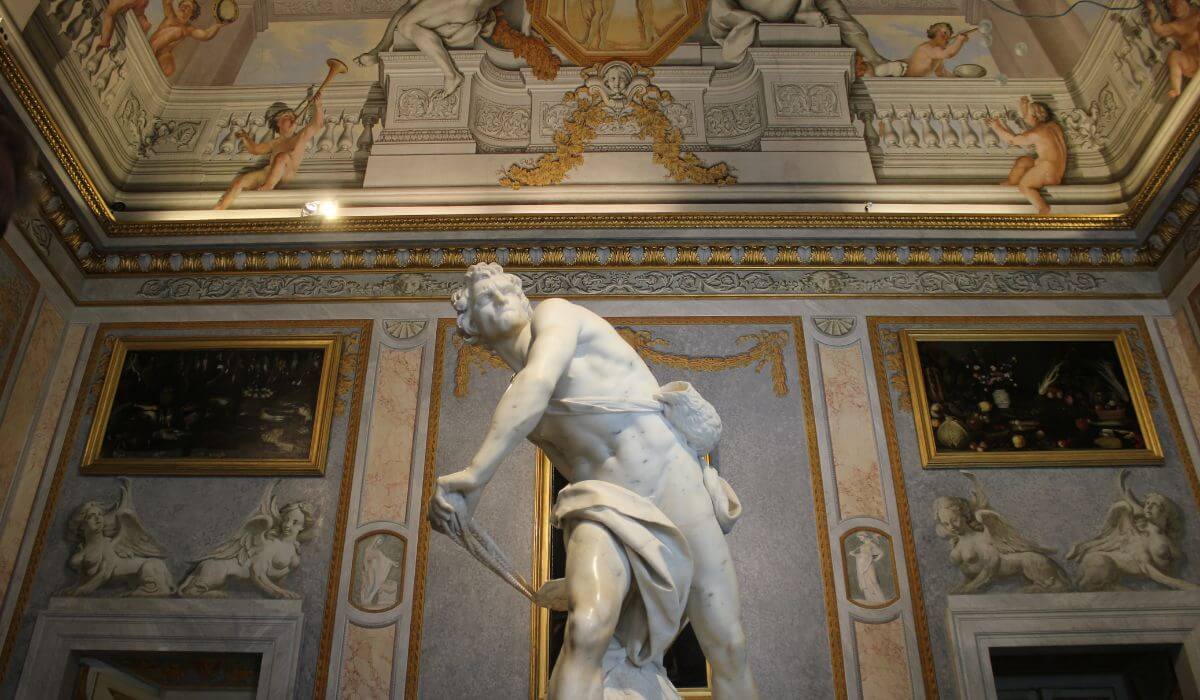
Bernini’s David is a life-size marble sculpture carved in 1623–1624 and displayed at the Borghese Gallery in Rome. It captures the biblical hero twisting his body to launch a stone at Goliath.
Unlike Michelangelo’s David, which shows the hero before the battle, Bernini’s figure is caught in action. The tense pose and concentrated expression make it a striking example of Baroque movement and emotion.
Bernini’s David: Key Facts
- Artist: Gian Lorenzo Bernini
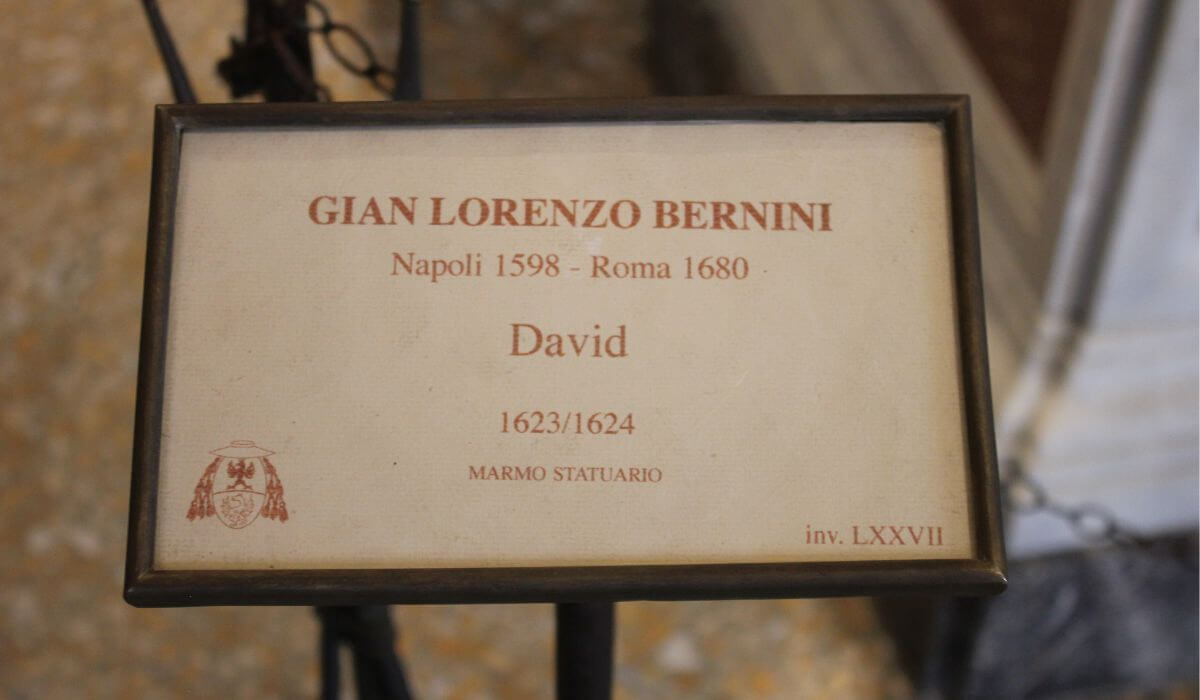
- Created: 1623–1624
- Subject: David preparing to throw a stone at Goliath
- Story source: The Bible, 1 Samuel 17
- Style: Baroque
- Material: White marble
- Height: 170 cm (about 5 ft 7 in)
- Location: Room 2 of the Borghese Gallery in Rome
- Admission: Included with your Borghese Gallery ticket; book a timed entry in advance
What does Bernini’s David depict?
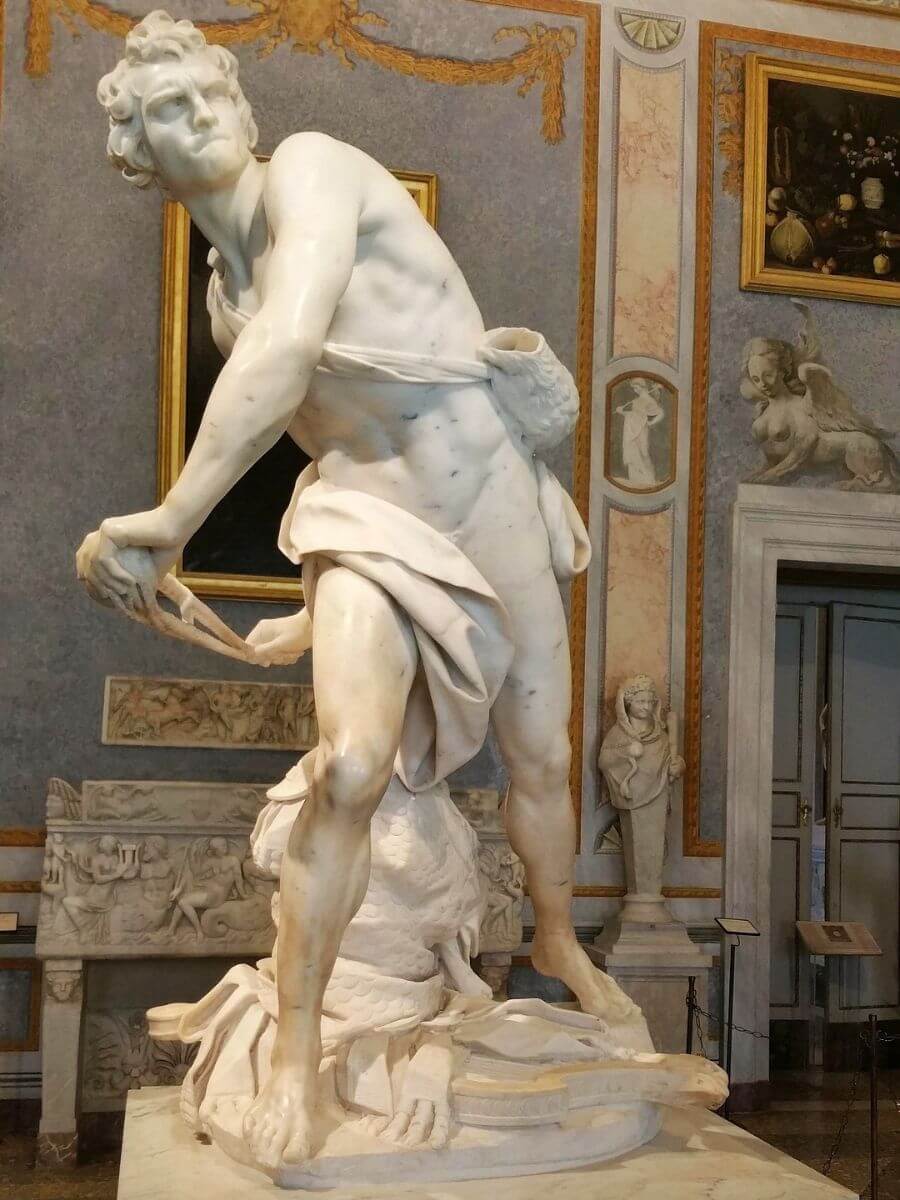
Bernini’s David shows the hero just before he launches a stone at Goliath. The giant is not represented, but David’s gaze suggests his position beyond the sculpture.
The story comes from 1 Samuel 17. David, a young shepherd, volunteers to fight Goliath, the Philistine champion feared by the Israelite army. He sets aside King Saul’s armor and faces the warrior with a sling and stones. A stone strikes Goliath in the forehead, bringing him down.
The biblical story celebrates faith and courage against a stronger opponent. Bernini focuses on the effort behind David’s victory, showing his determination through the tension in his body and face.
Bernini’s David: analysis and meaning
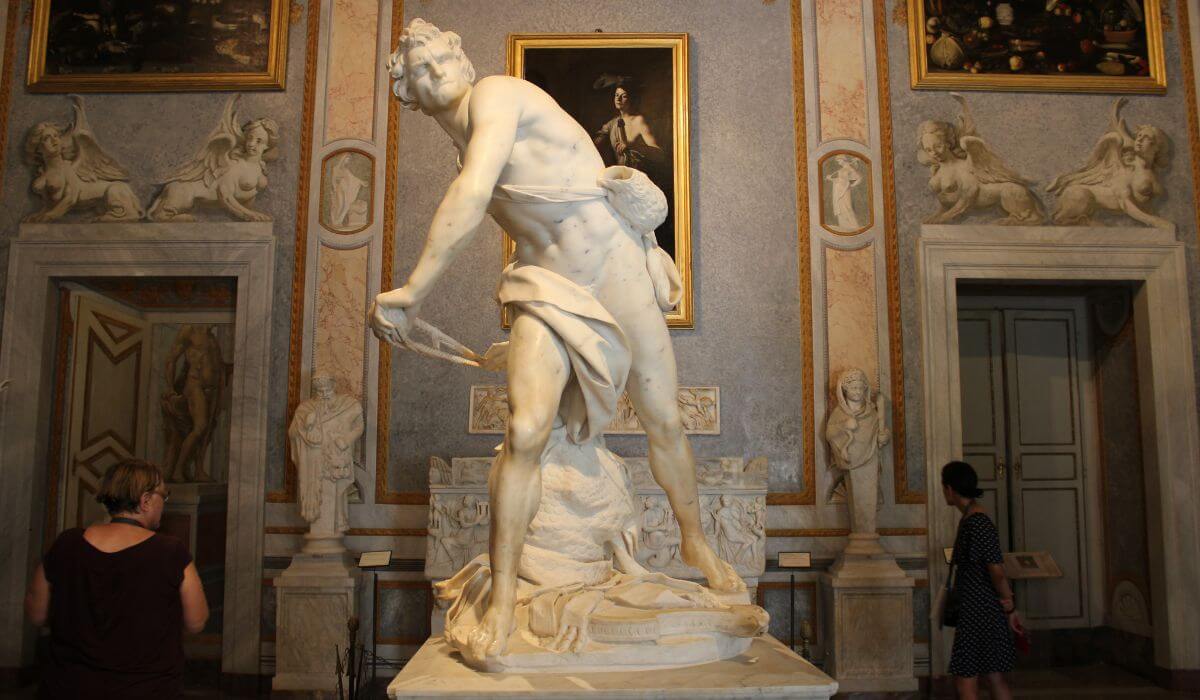
Bernini’s David combines movement, emotional intensity and interaction with the viewer’s space. These Baroque features turn a single marble figure into a scene of confrontation.
Movement and the viewer’s space
David’s legs brace his weight while his torso twists and his arms draw back the sling. These opposing movements create tension throughout the body. The diagonal arrangement of his limbs makes the pose feel active and unstable, despite the firmly planted feet.
His toes project beyond the base, and his gaze points toward Goliath’s imagined position. The confrontation extends into the room, drawing the viewer into the scene.
The sculpture originally stood against a wall, with a frontal view in mind. Parts of the back were left unfinished because Bernini did not expect them to be visible.
The gallery’s catalogue compares David’s pose with the Borghese Gladiator, an ancient statue then in the Borghese collection. It also notes similarities with Annibale Carracci’s Polyphemus fresco in Palazzo Farnese.
Facial expression and the self-portrait story
Look at David’s furrowed brow and bitten lower lip. They show the concentration of someone putting his whole body into a difficult movement.
David’s face is often identified as a self-portrait of Bernini. According to his early biographer Filippo Baldinucci, Cardinal Maffeo Barberini, the future Pope Urban VIII, held a mirror while the sculptor studied his own expression.
The armor and musical instrument
At David’s feet, three details connect the biblical story with the sculpture’s patron:
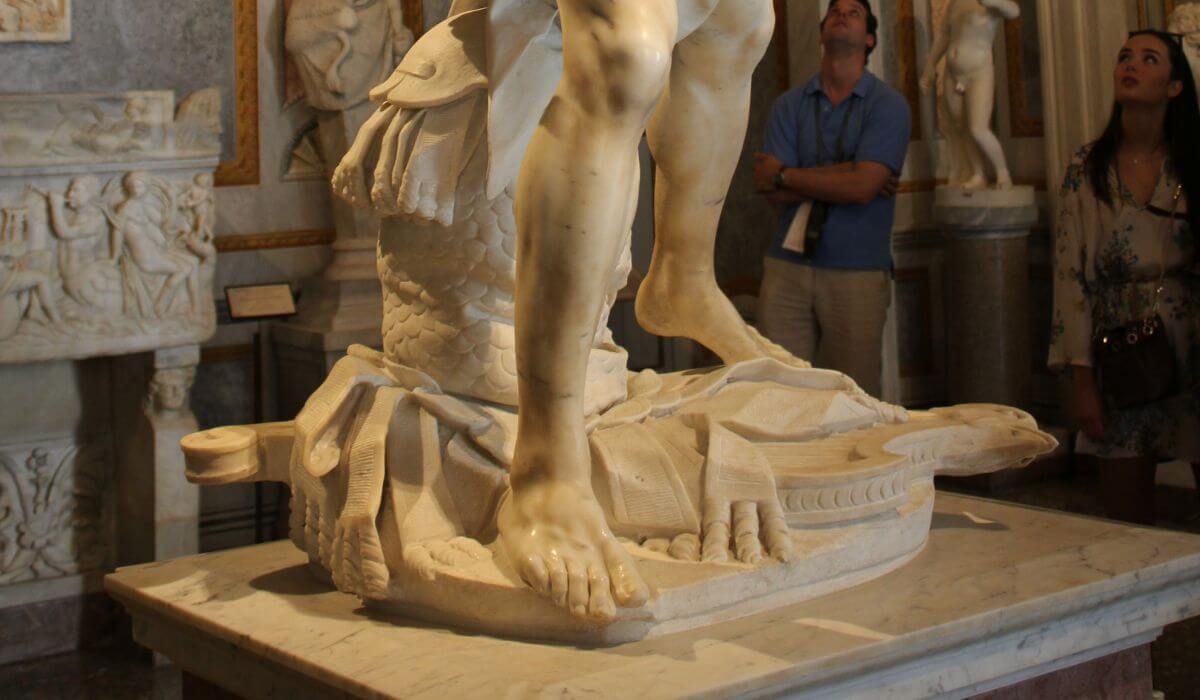
- Saul’s armor: David set aside the armor offered by the king before facing Goliath. In the sculpture, it also helps support the marble figure.
- The cithara: This lyre-like stringed instrument identifies David as a musician and psalmist.
- The eagle’s head: Carved at the end of the instrument, it refers to the Borghese family’s heraldry, linking the biblical hero to the family that commissioned the work.
Bernini vs Michelangelo: how do their Davids compare?
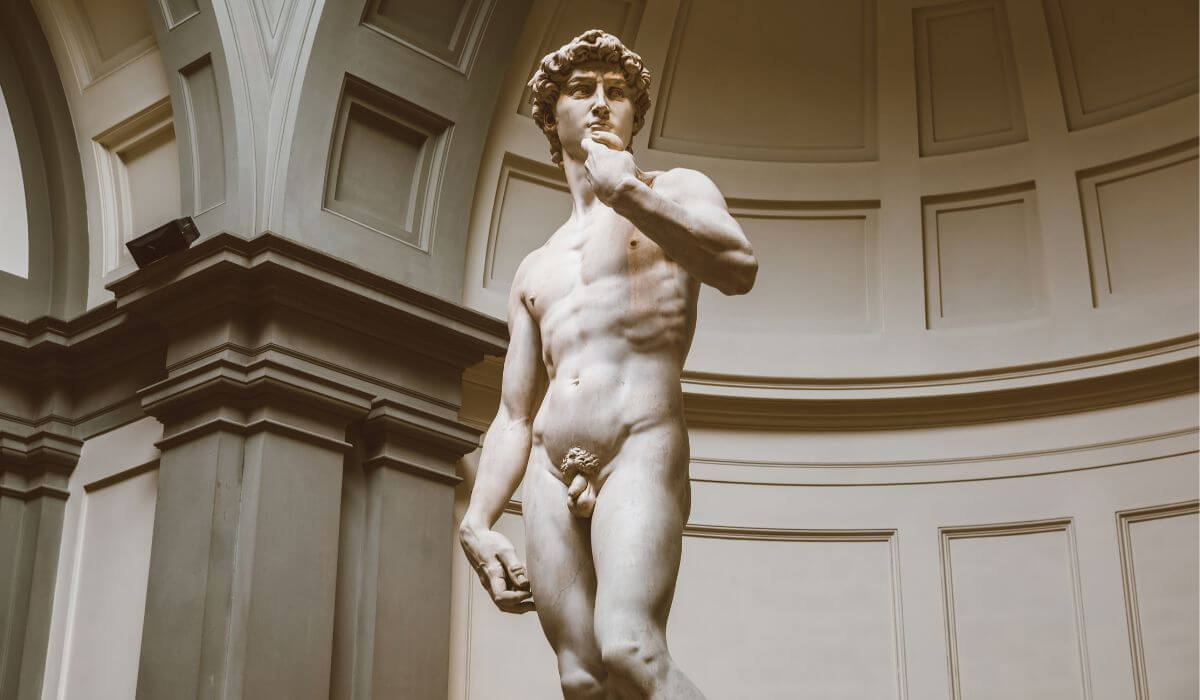
Michelangelo’s David shows the hero before the battle, standing still but alert. Bernini’s David captures him in action, twisting his body to throw the stone at Goliath.
Donatello’s bronze David shows a third moment: after the victory, with Goliath’s severed head at his feet.
Detail | Bernini’s David | Michelangelo’s David | Donatello’s bronze David |
Moment depicted | During the fight, preparing the throw | Before the battle | After the victory |
Pose | Twisting, braced and active | Upright, alert and still | Relaxed and triumphant |
Style | Baroque | High Renaissance | Early Renaissance |
Height | 170 cm | Over 5 meters | 158 cm |
Material | Marble | Marble | Bronze |
Date | 1623–1624 | 1501–1504 | Around 1440 |
Location | Borghese Gallery, Rome | Accademia Gallery, Florence | Bargello Museum, Florence |
Both Bernini’s and Michelangelo’s figures convey concentration and tension. Michelangelo expresses these through David’s alert gaze and controlled stance. Bernini emphasizes the physical effort of the throw, engaging the whole body in the action.
Who commissioned Bernini’s David?
Cardinal Montalto originally commissioned David in March 1623. After his death in June, Cardinal Scipione Borghese took over the project for his collection.
Bernini paused work on Apollo and Daphne to carve David in 1623–1624. According to his early biographer Filippo Baldinucci, the sculpture took approximately seven months to complete.
How to see Bernini’s David at the Borghese Gallery
Bernini’s David is in Room 2 on the ground floor of the Borghese Gallery, inside Villa Borghese park in Rome. It is included with your gallery admission ticket; no separate ticket is needed.
Tickets and opening hours
- Opening hours: Tuesday–Sunday, 9:00 am–7:00 pm. Closed Mondays, January 1 and December 25.
- Last regular entry: 5:45 pm.
- Visit duration: Two hours for the gallery, or one hour and 15 minutes for the 5:45 pm entry.
- Booking: Reserve your timed entry in advance. See our Borghese Gallery tickets guide for ticket options and booking details.
Limited last-minute tickets may be available at the museum’s ticket office, but entry is not guaranteed.
Where to stand and what to notice
Allow roughly 5–10 minutes to study David during your gallery visit.
- Start in front. Take in the whole pose, then look closely at David’s furrowed brow and bitten lower lip.
- Move to one side. Notice how the shoulders and hips turn in different directions, revealing the twist through the body.
- Check the base. Look for Saul’s discarded armor, the musical instrument and its eagle’s head.
- Compare the tension. Later, look at The Rape of Proserpina and notice how Bernini again shows the moment of greatest effort, with Pluto’s fingers pressing into Proserpina’s thigh as she strains away from him.
 For other works to include in your visit, explore our guide to Bernini’s sculptures at the Borghese Gallery.
Sources
- Galleria Borghese — David: official catalogue entry covering the commission, symbolism, self-portrait account and original display.
- Victoria and Albert Museum — Donatello’s David: background on the bronze sculpture and its interpretation.
- Galleria Borghese — Tickets and Opening Hours: official opening hours, timed entry and reservation requirements.
- Galleria Borghese — Visitor FAQs: visit duration and availability of last-minute tickets.

Fanny, a skilled writer with a keen interest in art and culture, has been enchanted by the Borghese Gallery’s exquisite collection and its history. As a significant contributor to the Visit Borghese Gallery blog, she artfully shares insights and stories, bringing the gallery’s masterpieces and the lush gardens to life for readers around the world.