
- On October 16, 2026
- In Art collections
David with the Head of Goliath by Caravaggio: Meaning and Self-Portrait
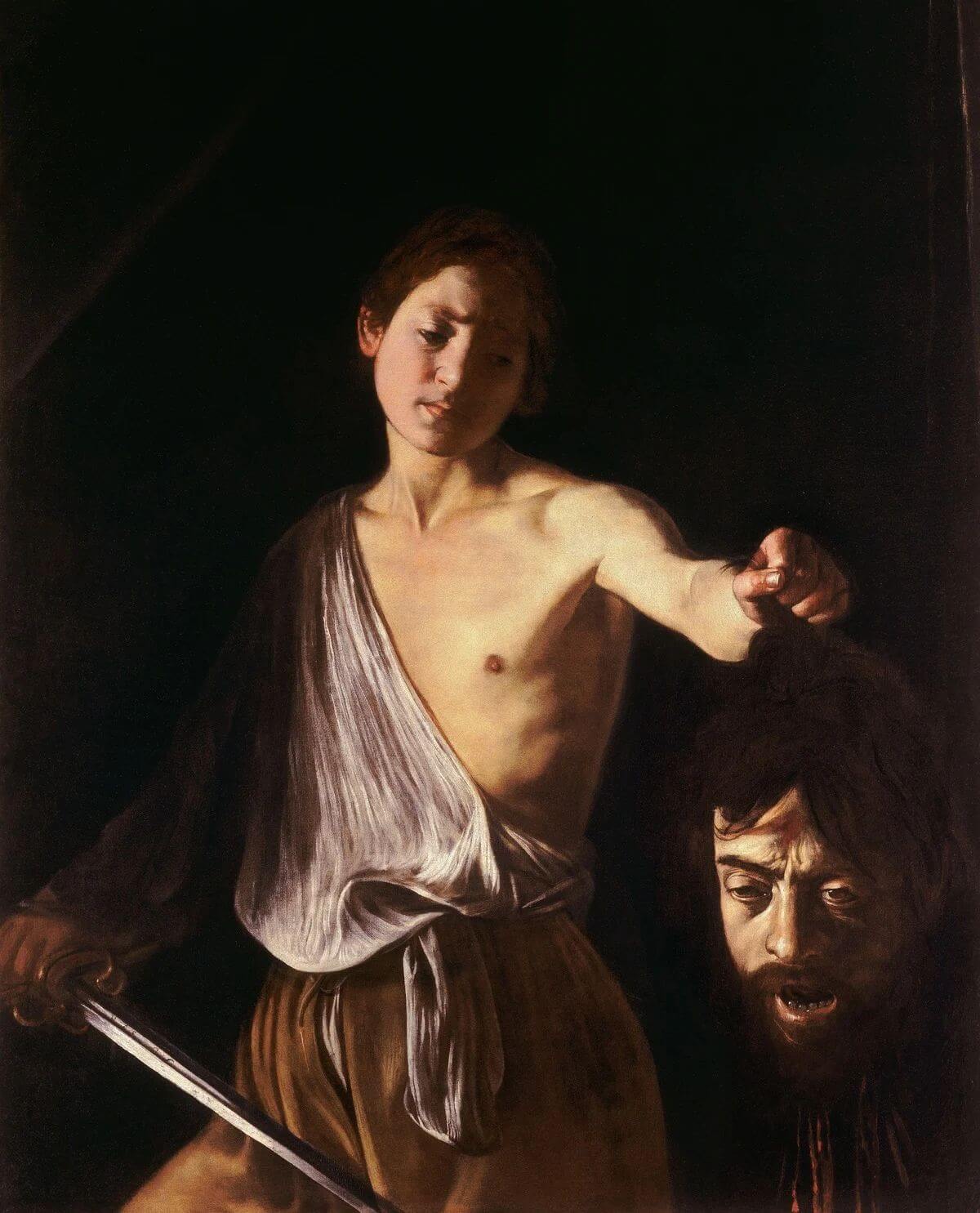
Caravaggio’s David with the Head of Goliath, displayed in Room 8 of the Borghese Gallery in Rome, shows the young David holding Goliath’s severed head by the hair. His sword is lowered, and his gaze rests on the defeated giant.
David’s downcast expression gives the scene a sorrowful mood. The Borghese Gallery identifies Goliath’s face as a self-portrait of Caravaggio. Scholars have connected this choice to the artist’s exile and a possible appeal for papal pardon.
David with the Head of Goliath by Caravaggio: Key Facts
- Artist: Caravaggio (Michelangelo Merisi)
- Date: 1606–1607 or 1609–1610 in the museum’s collection catalog; the dating remains debated.
- Medium: Oil on canvas
- Dimensions: 125 × 101 cm (height × width)
- Subject: David holding Goliath’s head after defeating him
- Location: Room 8 (Silenus Room), ground floor of the Borghese Gallery, Rome
- Admission: Included with museum admission; a timed reservation is required for all visitors.
What Does Caravaggio’s David with the Head of Goliath Depict?
Caravaggio depicts the aftermath of David’s victory over Goliath, the giant who challenges the Israelite army in 1 Samuel 17.
In the biblical account, David is a young shepherd who volunteers to face the Philistine warrior. He strikes Goliath in the forehead with a stone from his sling, then uses Goliath’s own sword to cut off his head.
The Borghese Gallery’s catalog relates the painting to a later moment in the story: David being brought before King Saul with Goliath’s head in his hand (1 Samuel 17:57). It identifies the dark curtain at the upper left as the entrance to Saul’s tent.
David with the Head of Goliath: A Closer Look
David’s Expression and Gesture
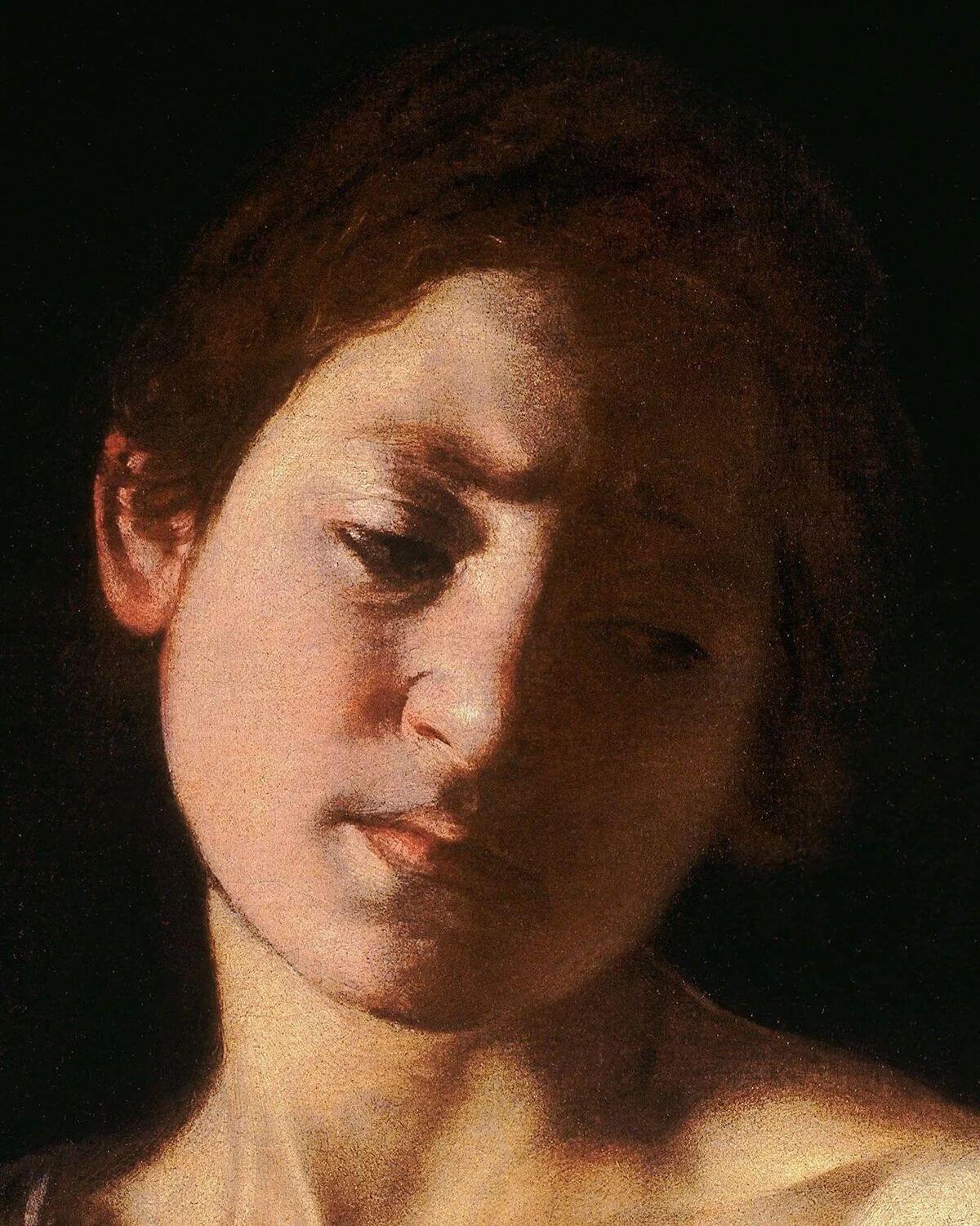
David tilts his head and looks down at Goliath. His lips are slightly parted, and his brow is drawn. The Borghese Gallery describes his expression as sad and moved, giving the victorious figure an unexpected tenderness.
His extended arm holds the head away from his body, while his other hand keeps the sword low. The violence has ended, but its result remains in front of him. The gesture leaves space between the two faces, so we can follow David’s gaze toward the man he has killed.
Light, Darkness, and Goliath’s Head
Light catches David’s face, bare chest, and outstretched arm. Deep shadows hide much of the setting, while the pale folds of his shirt stand out against the background. This strong contrast between light and dark, known as chiaroscuro, gives the figure volume and directs attention to his face and hands.
Below David’s hand, Goliath’s head hangs at an angle. His open mouth and the blood at the cut neck make the killing painfully concrete. David’s smooth, youthful face contrasts with Goliath’s furrowed brow and strained features.
The Inscription on the Sword
The sword bears faint letters recorded in the museum’s catalog as “H.AS O S.” One influential interpretation expands them into the Latin phrase Humilitas occidit superbiam: “Humility kills pride.” In this reading, David’s victory becomes a moral image of humility overcoming arrogance.
The inscription’s meaning remains debated. Other scholars have read the marks as Caravaggio’s signature or a sword maker’s brand. The Latin motto is an interpretation of the abbreviated letters, not a complete phrase clearly written on the blade.
Is Goliath a Self-Portrait of Caravaggio?
The Early Identification of Goliath’s Face
The Borghese Gallery identifies Goliath’s face as Caravaggio’s self-portrait. This identification goes back to Iacomo Manilli’s 1650 guide to the collection, which states that the artist portrayed himself as the giant. It gives the severed head a personal significance within the biblical scene.
Young Sick Bacchus, another painting in the Borghese collection, is also commonly interpreted as a self-portrait.
Caravaggio’s Exile and the Search for a Pardon
In 1606, Caravaggio killed Ranuccio Tomassoni during a fight in Rome. He fled the city and was sentenced to death in his absence. His subsequent years took him to Naples, Malta, and Sicily, while he sought a papal pardon that would allow him to return to Rome.
Art historian Maurizio Calvesi proposed in 1985 that the painting was intended as an appeal for pardon. In this interpretation, Caravaggio offered his own painted head in place of an execution. The canvas would have been a gift for Pope Paul V, delivered through the pope’s nephew, Cardinal Scipione Borghese.
The sorrowful David and the possible message of humility on the sword support this reading. The painting’s intended role in securing a pardon remains a hypothesis.
Who Is David?
David’s identity is less certain. Manilli called him Caravaggio’s “Caravaggino,” a name that scholars have connected to different people, including the painter Cecco del Caravaggio. Art historian Sergio Rossi interpreted the two figures as a double self-portrait, with Caravaggio represented as both executioner and victim.
These proposals concern different questions: who may have posed for David, and what the figure may represent. The young man’s identity remains unresolved.
When Was the Painting Made?
Why the Date Remains Debated
The Borghese Gallery’s catalog gives two possible dates: 1606–1607 or 1609–1610. The earlier date places it near the end of Caravaggio’s Roman period or during his first stay in Naples; the later date places it during his second stay there.
Many scholars favor the later period, linking the restricted range of colors and treatment of light to his final paintings. Technical examinations, however, have revealed incised, or scratched, lines and preparatory work comparable to paintings from 1606–1607. The worn paint surface also complicates comparisons of style, leaving the date open to discussion.
From Naples to the Borghese Collection
The painting is documented in Scipione Borghese’s collection by 1613. That year, a payment to cabinetmaker Annibale Durante records a frame for a painting of David with Goliath’s head whose dimensions correspond roughly to this canvas. Scipione Francucci also described it in the collection in 1613.
How it reached Rome remains uncertain. Scholars have suggested that Caravaggio took it with him when he left Naples in July 1610, but its presence among his luggage has not been established.

Caravaggio’s David Paintings in Rome, Vienna, and Madrid
How the Rome and Vienna Paintings Differ
Caravaggio returned to the story of David and Goliath in several distinct compositions. The painting in Vienna’s Kunsthistorisches Museum shows David carrying the sword across his shoulder and holding Goliath’s head out by the hair. He turns his face to the side. In the Borghese painting, the lowered sword and downward gaze bring his attention back to the severed head.
Their supports also differ. The Vienna painting is on poplar wood, while the Borghese version is on canvas. The Kunsthistorisches Museum dates its painting to around 1600–1601, earlier than either date proposed in the Borghese catalog for the Rome painting.
The Earlier Painting at the Prado
The Museo Nacional del Prado in Madrid dates its David with the Head of Goliath to around 1600. It is also painted in oil on canvas.
Here, David bends over Goliath’s body and gathers the severed head’s hair to tie it with a rope. The head lies close to the bottom of the canvas. This composition keeps David beside the fallen giant, showing him preparing the head to carry away.
How to See David with the Head of Goliath at the Borghese Gallery
Caravaggio’s David with the Head of Goliath is displayed in Room 8, the Silenus Room, on the ground floor of the Borghese Gallery in Rome.
Start a few steps back to follow the line from David’s face along his extended arm to Goliath’s head. Then move closer to compare the two expressions and the light on David’s chest and shirt. Look for the small marks on the sword, keeping in mind that the abbreviated inscription can be difficult to make out.
Elsewhere in the museum, Bernini’s David shows the hero preparing to launch his stone. Together, the two works show the effort of the throw and the aftermath of the killing.
Practical information
- Opening hours: Tuesday–Sunday, 9 a.m.–7 p.m. Last admission is at 5:45 p.m.
- Visit duration: Standard museum visits last two hours. The final 5:45 p.m. entry allows 1 hour 15 minutes.
- Closures: Mondays, January 1, and December 25. Check the museum’s official visit notices for exceptions and temporary closures.
- Reservations: A timed reservation is required for all visitors, including those eligible for free admission. Access to the painting is included with museum admission.
 See our Borghese Gallery tickets guide for booking options and practical advice.
Sources
- Galleria Borghese — David with the Head of Goliath: Antonio Iommelli’s collection catalog entry, covering the disputed dating, provenance, self-portrait identification, and interpretations of the sword inscription.
- Kunsthistorisches Museum — David with Goliath’s Head: the Vienna painting’s date, poplar support, and composition.
- Museo Nacional del Prado — David with the Head of Goliath: the Madrid painting’s date, technique, and treatment of the biblical episode.
- The Bible — 1 Samuel 17, via New Advent: the account of David’s victory, the beheading of Goliath, and David’s appearance before Saul.
- The National Gallery — Michelangelo Merisi da Caravaggio: background on the artist’s flight from Rome, travels, and pursuit of a papal pardon.

Fanny, a skilled writer with a keen interest in art and culture, has been enchanted by the Borghese Gallery’s exquisite collection and its history. As a significant contributor to the Visit Borghese Gallery blog, she artfully shares insights and stories, bringing the gallery’s masterpieces and the lush gardens to life for readers around the world.