

- On October 19, 2026
- In Art collections
Boy with a Basket of Fruit by Caravaggio: The Boy, the Fruit, and the Meaning
Caravaggio’s Boy with a Basket of Fruit, in the Borghese Gallery in Rome, shows a young man holding a wicker basket filled with fruit and leaves. His head tilts to one side, and his loose white shirt leaves one shoulder bare. Light catches his face, shoulder, and the fruit, while shadows separate the grapes and folds of fabric.
The painting brings together a human figure and a closely observed still life. The fruit looks ripe and inviting, but some leaves show damage. Scholars have interpreted the painting in terms of desire, religious love, and the passing of time; others see a study of nature without a symbolic message.
Boy with a Basket of Fruit by Caravaggio: Key Facts
- Artist: Michelangelo Merisi da Caravaggio (1571–1610)
- Date: c. 1595; the exact dating is debated
- Medium: Oil on canvas
- Dimensions: 70 × 67 cm (height × width)
- Subject: A young man holding a basket of fruit
- Location: Borghese Gallery, Rome, Room 8 (Silenus Room)
- Inventory number: 136
Who Is the Boy in Caravaggio’s Painting?
The Traditional Identification as Mario Minniti
The boy is traditionally identified as Mario Minniti, a Sicilian painter. The identification draws partly on the resemblance between a later engraved portrait of Minniti and a young model who appears in several of Caravaggio’s early works. That comparison supports the suggestion, although the sitter’s identity remains uncertain.
The Gaze, Pose, and Bare Shoulder
The boy turns his face toward us, with his lips slightly parted. His shirt gathers in loose folds below the bare shoulder, while both arms support the basket.
The basket rests against his chest, partly hiding his torso. His face, bare shoulder, and the fruit form a compact group, giving the scene a sense of closeness.
Boy with a Basket of Fruit: A Closer Look
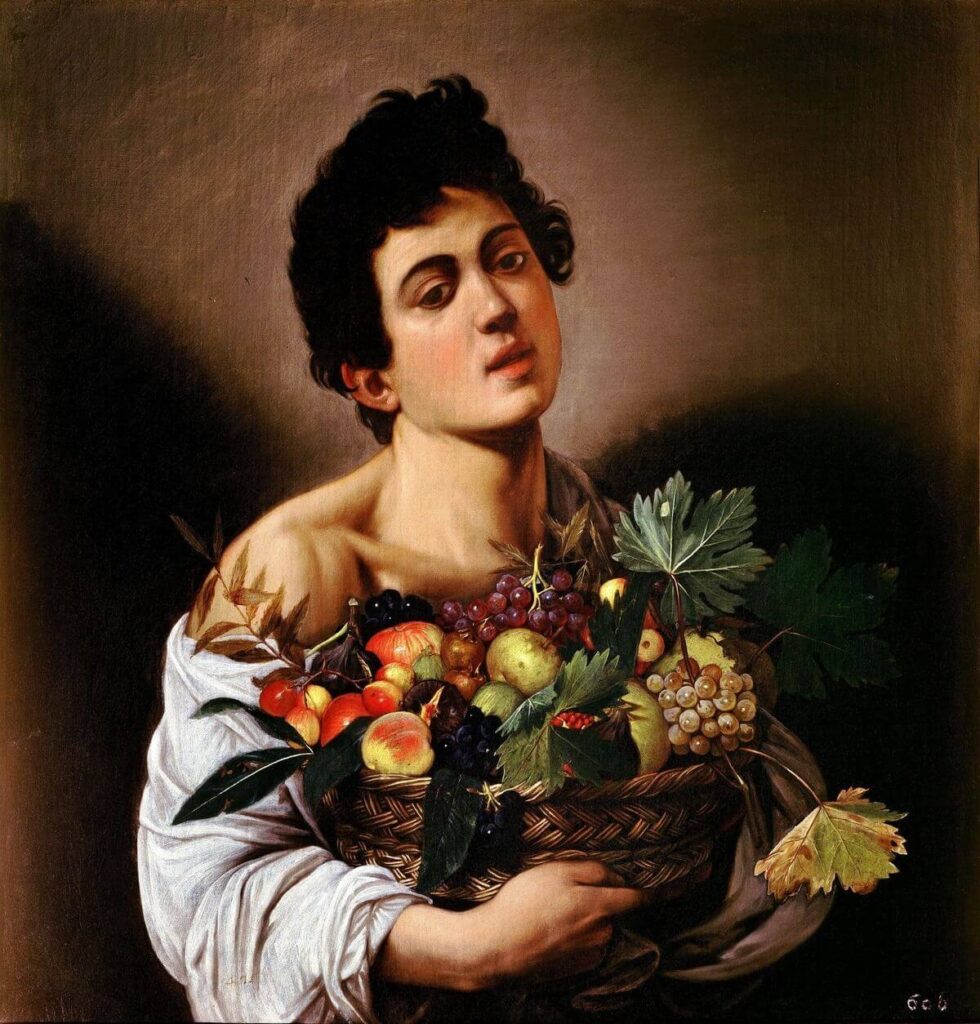
The Fruit and Damaged Leaves
Clusters of dark and pale grapes, apples, pears, figs, a peach, and a split pomegranate fill the basket. The fruit varies in shape and color: grapes hang in bunches, apples are round and glossy, and the pomegranate exposes its red seeds.
The fruit is largely ripe and sound, but the foliage shows more wear. Broad green leaves sit alongside others with spots and dry, yellow-brown edges. The damaged leaves give the abundant arrangement the irregularities of plants observed from life.
Light, Color, and Texture
Light catches the face, bare shoulder, and fruit, while the hair and the spaces between the grapes remain dark. The contrast gives the boy and the basket volume against the plain wall.
Compare the skin, cloth, and wicker. The shoulder looks smooth, the shirt gathers in soft folds, and the wicker strips cross at angles. Small highlights on the grapes and fine lines on the leaves distinguish their surfaces too.
How It Differs from Basket of Fruit in Milan
Caravaggio’s Basket of Fruit (Canestra di frutta) shows a basket resting on a ledge, with no human figure. In that painting, the fruit and foliage are the entire subject. Here, the boy’s face, body, and gesture share the viewer’s attention with the basket.
They are two separate paintings in different collections: Boy with a Basket of Fruit belongs to the Borghese Gallery in Rome, while Basket of Fruit is at the Pinacoteca Ambrosiana in Milan.
What Does Boy with a Basket of Fruit Mean?
Desire and Religious Interpretations
Art historian Donald Posner interpreted the painting as carrying an erotic message.
Maurizio Calvesi proposed a Christian reading: the boy represents Christ, and offering the basket expresses Christ’s gift of himself to humanity.
Youth, Passing Time, and Realism
The contrast between a young figure and aging leaves has also suggested the passing of time. Art historian Giulio Carlo Argan read the damaged foliage as a reminder that beauty fades. Other scholars have connected the subject with youth or vanitas—the idea that life and its pleasures are temporary.
A reading centered on realism gives the details another purpose. The leaves, fruit, and boy show Caravaggio observing nature closely, without requiring a hidden meaning for each object. The painter’s intended message remains uncertain.

Caravaggio’s Early Roman Years and the Painting’s History
Dating the Painting and the Cavalier d’Arpino’s Workshop
Boy with a Basket of Fruit belongs to Caravaggio’s early years in Rome, when he worked in Giuseppe Cesari’s workshop. Cesari was known as the Cavalier d’Arpino, and Caravaggio was employed there to paint fruit and flowers.
The Borghese Gallery dates the painting to around 1595, though its exact date remains debated alongside the chronology of Caravaggio’s arrival in Rome.
Technical examinations in 2012 revealed a preparatory drawing beneath the paint, sketched directly on the canvas.
How It Entered the Borghese Collection
The painting entered the Borghese collection in 1607 after Cesari’s pictures were confiscated. Pope Paul V’s authorities had accused Cesari of illegally possessing firearms, and he was forced to surrender his collection to the Apostolic Chamber.
The pope then gave the paintings to his nephew, Cardinal Scipione Borghese. Boy with a Basket of Fruit and Caravaggio’s Sick Bacchus were both part of this transfer.

How to See Boy with a Basket of Fruit at the Borghese Gallery
Look for Boy with a Basket of Fruit in Room 8, the Silenus Room, on the ground floor of the Borghese Gallery in Rome.
First take in how the basket rests against the boy’s chest. Then look more closely at the highlights on the grapes and the spotted, yellow-brown edges of the leaves. Compare the smooth shoulder with the folded shirt and woven wicker.
Practical information
- Opening hours: Tuesday–Sunday, 9 a.m.–7 p.m. Last admission is at 5:45 p.m. Closed on Mondays, January 1, and December 25.
- Reservations: A timed reservation is required for all visitors, including those eligible for free admission.
- Visit duration: Standard museum visits last two hours. The final 5:45 p.m. entry allows 1 hour 15 minutes.
- Tickets: Access to the painting is included in museum admission; no separate ticket is needed.
 See our Borghese Gallery tickets guide for booking options and practical advice.
Sources
- Galleria Borghese — Boy with a Basket of Fruit: Antonio Iommelli’s catalog entry (2022), covering the painting’s dating, provenance, technical findings, and scholarly interpretations.
- Treccani — Mario Minniti: Donatella Spagnolo’s biographical entry (2010), providing context for the traditional identification of Caravaggio’s young model.
- Jules Janick — Caravaggio’s Fruit: A Mirror on Baroque Horticulture: A botanical study in Chronica Horticulturae (2004), identifying the fruit and examining the condition of the foliage.
- Galleria Borghese — Room 8: Silenus Room: The museum’s description of the ground-floor room and its Caravaggio paintings.
- Galleria Borghese — Visit: Official information on opening hours, reservations, timed visits, and temporary closures.

Fanny, a skilled writer with a keen interest in art and culture, has been enchanted by the Borghese Gallery’s exquisite collection and its history. As a significant contributor to the Visit Borghese Gallery blog, she artfully shares insights and stories, bringing the gallery’s masterpieces and the lush gardens to life for readers around the world.