
- On October 13, 2026
- In Art collections
Basket of Fruit by Caravaggio: Analysis and Meaning
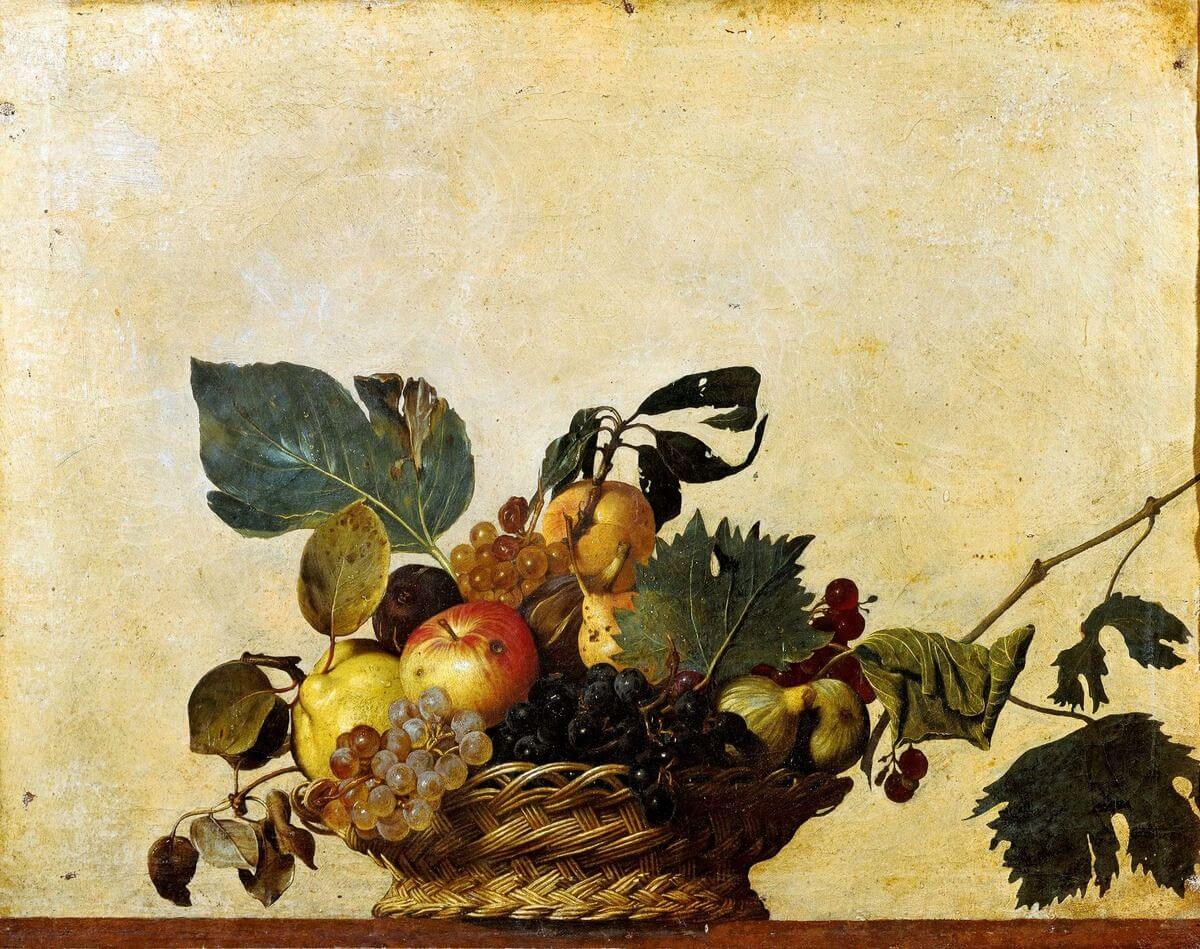
Caravaggio’s Basket of Fruit shows a wicker basket filled with fruit and leaves, set against a pale background. The basket projects slightly over the ledge beneath it, while blemished fruit and curling leaves interrupt the impression of abundance. These details give the still life its tension between ripeness and decay.
The painting belongs to the Pinacoteca Ambrosiana in Milan. It is a different work from Boy with a Basket of Fruit, the painting of a young man holding fruit at Rome’s Borghese Gallery.
Basket of Fruit by Caravaggio : Key Facts
- Artist: Michelangelo Merisi da Caravaggio (1571–1610)
- Italian title: Canestra di frutta
- Date: Late 1590s–early 1600s; the exact date is debated
- Medium: Oil on canvas
- Dimensions: 47 × 61 cm (about 18.5 × 24 inches)
- Collection: Pinacoteca Ambrosiana, Milan
- Provenance: Donated by Cardinal Federico Borromeo in 1618
What Makes Caravaggio’s Basket of Fruit Important?
Fruit as the Main Subject
Fruit is the entire subject of this painting. There is no figure to hold the basket and no larger scene to explain its presence. The weave of the wicker, the weight of the fruit, and the varied shapes of the leaves give an everyday arrangement enough visual interest to fill a canvas.
This focus makes Basket of Fruit a landmark in the development of still-life painting. The Ambrosiana describes it as a prototype of the genre. Its importance lies in the attention Caravaggio gives to ordinary things: their textures, imperfections, and physical presence become the painting’s central concern.
Dating and Federico Borromeo’s Collection
Caravaggio painted Basket of Fruit in Rome, but its exact date remains uncertain. The Ambrosiana places it between the closing years of the 16th century, after 1597, and the beginning of the 17th. This is why a date such as “1599” should be understood as an estimate.
The painting entered the Ambrosiana through Cardinal Federico Borromeo’s donation in 1618, alongside the collection that formed the museum’s founding nucleus. For Borromeo, nature’s variety and beauty were gifts to be appreciated. The basket therefore fits into a broader collecting interest in the natural world, shared by the landscapes and flower paintings he admired.
Basket of Fruit: A Closer Look
The Basket Projecting Over the Ledge
The ledge forms a narrow strip along the bottom of the canvas. Seen almost at eye level, the basket projects beyond the ledge, casting a shadow beneath its base. This small detail makes it seem to reach out toward the viewer.
Caravaggio creates depth without showing a room or a broad tabletop. The basket’s rim partly hides the fruit, the grapes overlap, and leaves extend to either side. These details give the arrangement volume against the plain background.
Light, Background, and Texture
The pale background makes the outlines of the fruit and leaves easy to follow. Light catches individual grapes, while shadows between them separate one from another. Across the basket, alternating light and dark reveal how the wicker strips weave together.
 Look at the differences in texture: the smooth skin of the fruit, the uneven wicker, and the fine veins running through the leaves. Caravaggio gives each surface its own appearance, making the objects feel tangible.
Ripe Fruit, Damaged Skin, and Wilting Leaves
The apple near the center-left has a dark blemish in its red and yellow skin. Some leaves are broad and green; others have holes, brown edges, or tips that curl inward.
These marks interrupt the impression of abundance. The fruit looks full and ripe, but the foliage is already deteriorating in places. Freshness and decay appear together, giving this everyday arrangement a sense of time passing.
What Does Basket of Fruit Mean?
Time, Decay, and the Vanitas Reading
The painting invites a simple reflection: beauty and abundance do not last. What looks ready to be enjoyed is also passing away. The basket holds the promise of nourishment and pleasure, together with signs that both are temporary.
This is the central idea behind a vanitas reading. In art, vanitas draws attention to the brevity of life and the fleeting value of earthly pleasures. Caravaggio’s fruit brings that idea into an everyday setting: the familiar experience of food ripening and spoiling becomes a way to think about our own mortality.
Realism and Religious Interpretations
For Federico Borromeo, nature’s variety and beauty were gifts to be appreciated. A Christian reading of the painting connects that abundance with the generosity of creation, while its deterioration recalls the limits of earthly life. The basket can therefore invite both gratitude for what sustains us and reflection on how briefly we possess it.
Here, realism and symbolism work together. The appeal of the fruit makes its eventual loss meaningful: something desirable is already beginning to fade. The Ambrosiana acknowledges religious interpretations, but the painting’s precise spiritual message remains open to discussion.
Basket of Fruit vs. Boy with a Basket of Fruit
These are two separate paintings by Caravaggio, both showing his close attention to fruit and its natural imperfections. In Boy with a Basket of Fruit, a young man holds the basket against his body, and his face and pose share the viewer’s attention with the fruit. In Basket of Fruit, the basket and its contents form the entire subject.
The paintings belong to different museums: Boy with a Basket of Fruit is at the Borghese Gallery in Rome, while Basket of Fruit belongs to the Pinacoteca Ambrosiana in Milan.

Where to See Basket of Fruit in Milan?
Visiting the Pinacoteca Ambrosiana
You can see Basket of Fruit in Room 1 of the Pinacoteca Ambrosiana, at Piazza Pio XI, 2, in Milan. Nearby metro stops include Duomo and Cordusio.
The museum is open from 10 a.m. to 6 p.m. and closed on Wednesdays. The ticket office closes at 5:15 p.m. Allow around 90 minutes if you would like to explore the full collection as well as Caravaggio’s painting.
Tickets and Planning Your Visit
Standard admission to the Pinacoteca costs €17. A combined ticket for the Pinacoteca and the San Sepolcro Crypt costs €20.
Reservations carry an additional booking fee of €1.50 per ticket.
Before choosing your date, check the Ambrosiana’s official visitor and ticket guide for current prices, reduced rates, and any changes to opening hours.
Sources
- Pinacoteca Ambrosiana — Basket of Fruit: official artwork entry covering the painting’s date, dimensions, provenance, and interpretations.
- Ambrosiana — Nature in Federico Borromeo’s Collection: museum commentary on Borromeo’s appreciation of nature and its relevance to the collection.
- The Metropolitan Museum of Art — Vanitas Still Life by Jacques de Gheyn II: background on vanitas and the theme of life’s brevity.
- Ambrosiana — Pinacoteca Visitor Information: the painting’s location, opening hours, admission prices, and suggested visiting routes.

Fanny, a skilled writer with a keen interest in art and culture, has been enchanted by the Borghese Gallery’s exquisite collection and its history. As a significant contributor to the Visit Borghese Gallery blog, she artfully shares insights and stories, bringing the gallery’s masterpieces and the lush gardens to life for readers around the world.
Will make it a stop on our next trip to Italy, just to see the Caravaggio’s