
- On November 11, 2026
- In ABOUT VILLA BORGHESE Art collections
Madonna of the Palafrenieri: Caravaggio’s Virgin, Child, and Serpent
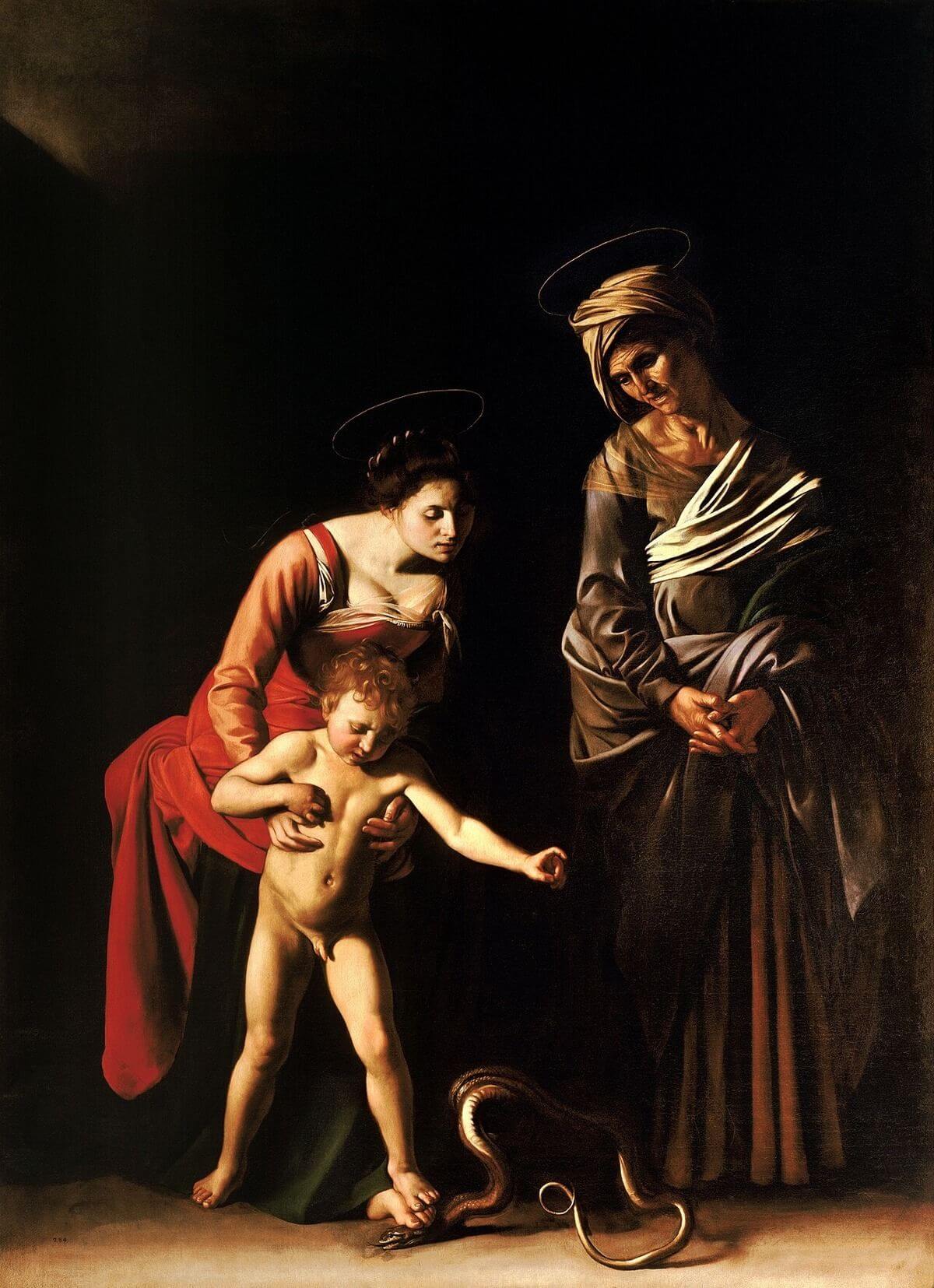
Caravaggio painted Madonna of the Palafrenieri for an altar in St. Peter’s Basilica. It left the church soon after it arrived, and the reasons for its removal are still debated.
Today, you can see it in Rome’s Borghese Gallery. Mary holds Jesus steady as they crush a serpent underfoot, while Saint Anne watches nearby. The gesture brings a surprisingly familiar moment into this religious scene: a mother helping her child.
Madonna of the Palafrenieri: Key Facts
- Artist: Michelangelo Merisi da Caravaggio (1571–1610).
- Other titles: Madonna dei Palafrenieri; Madonna of the Grooms; Madonna and Child with Saint Anne; Madonna of the Serpent.
- Date: 1605–1606; commissioned in 1605 and delivered in April 1606. The Borghese catalog dates it to 1605.
- Medium: Oil on canvas.
- Size: 292 × 211 cm (about 9 ft 7 in × 6 ft 11 in), height × width, according to the Borghese catalog.
- Original destination: The altar of the papal grooms’ confraternity in St. Peter’s Basilica.
- Location: Room 8, the Silenus Room, at the Borghese Gallery in Rome.
Mary and Jesus Crushing the Serpent
The serpent lies beneath Mary’s bare foot, with Jesus’s left foot resting on top of hers. She supports his body with both hands as he leans into the action.
The serpent points to Genesis 3:15, where God addresses it after the Fall. Christians have read its defeat as a promise of Christ’s victory over evil. A Latin reading of the verse used ipsa, “she,” which helped inspire images of Mary crushing its head.
Art historian Antonio Mazzotta, writing for the Visual Commentary on Scripture, links Mary and Jesus’s shared action to debates over their roles in defeating sin. He also connects it with the Immaculate Conception: the belief that Mary was free from original sin from the moment she herself was conceived. This concerns Mary’s conception, rather than the virgin birth of Jesus.
Saint Anne and the Light Around Her
Saint Anne is Mary’s mother and Jesus’s grandmother. At the right, she watches with her hands clasped. Her upright pose contrasts with Mary’s forward bend and the child’s outstretched arm.
Saint Anne was the patron saint of the confraternity that commissioned the painting: the Palafrenieri, or papal grooms. Their name also explains the English title, Madonna of the Grooms.
The light picks out the child’s bare limbs against the dark background. Anne’s lined face and covered body are less brightly lit, so her features are harder to make out.
In Room 6, Bernini’s Aeneas, Anchises and Ascanius brings three generations together in marble. Compare Mary supporting her child with Aeneas carrying his elderly father.
Why Was the Painting Removed from St. Peter’s?
The confraternity commissioned a new altarpiece in 1605 as work on St. Peter’s changed the setting of its chapel. Caravaggio’s canvas replaced an older image of Mary, Jesus, and Saint Anne. It was delivered in April 1606 and taken to the nearby church of Sant’Anna dei Palafrenieri soon afterward.
The reason for its removal remains uncertain. Antonio Iommelli’s Borghese catalog entry considers several possibilities. Mary’s low neckline, the fully nude child, or Anne’s appearance as an ordinary elderly woman may have seemed unsuitable for an altar. Other explanations concern the religious meaning of Mary and Jesus crushing the serpent together, or whether the canvas fit the space it was painted for.
Mary’s model may have been a woman called Lena, sometimes identified as Maddalena Antognetti. Archival researchers Francesca Curti and Orietta Verdi challenge the documentary basis for linking Antognetti to Caravaggio. The model’s identity remains uncertain.
Cardinal Scipione Borghese bought the painting in 1606 for 100 scudi, taking the altarpiece into his private collection.
Seeing Madonna of the Palafrenieri at the Borghese Gallery
The painting is displayed in Room 8, the Silenus Room, on the ground floor.
Begin far enough back to take in the tall canvas. Follow the slope from Mary’s bowed head through the child toward the floor, then look across to Anne’s upright figure. Move closer to see how the small highlights on the snake’s coils distinguish it from the surrounding darkness.
In the same room, compare Anne’s stillness with Caravaggio’s Saint Jerome. Jerome bends over his book with an arm extended across the table; Anne keeps her hands together as she watches.
Also in Room 8, Caravaggio’s David with the Head of Goliath gives you another downward gaze to follow, from David’s face to the head he holds.
Practical information
- Admission: The painting is included in a Borghese Gallery visit; it does not require a separate artwork ticket.
- Hours: The gallery opens Tuesday through Sunday, 9 a.m.–7 p.m., with the last entry at 5:45 p.m.
- Closures: Monday is the usual closing day; January 1 and December 25 are also closed. Consult the museum’s official visitor information for exceptions.
- Time in the museum: A standard visit allows two hours for the collection. The final 5:45 p.m. entry ends at 7 p.m., leaving 75 minutes.
 Booking: Reserve a timed entry before visiting, including for free admission. Our Borghese Gallery tickets guide outlines booking options; use the official museum information for current admission rules and concessions.
Sources
- Galleria Borghese collection catalog — Madonna and Child with Saint Anne. Antonio Iommelli’s May 2023 entry documents the commission, collection history, and competing explanations for removal.
- Visual Commentary on Scripture — Crushing the Serpent. Antonio Mazzotta explains the overlapping feet and the painting’s religious interpretation.
- USCCB — Genesis 3, note on verse 15. Distinguishes the biblical passage from later Christian interpretations involving Christ and Mary.
- Francesca Curti and Orietta Verdi — Caravaggio, Lena and Maddalena Antognetti. Examines the disputed documentary basis for identifying Lena with Antognetti.
- Galleria Borghese — The Villa and its rooms. Identifies Room 8 among the ground-floor rooms.

Fanny, a skilled writer with a keen interest in art and culture, has been enchanted by the Borghese Gallery’s exquisite collection and its history. As a significant contributor to the Visit Borghese Gallery blog, she artfully shares insights and stories, bringing the gallery’s masterpieces and the lush gardens to life for readers around the world.