- On October 28, 2026
- In ABOUT VILLA BORGHESE Art collections
Saint Jerome by Caravaggio: The Writing Saint at the Borghese Gallery
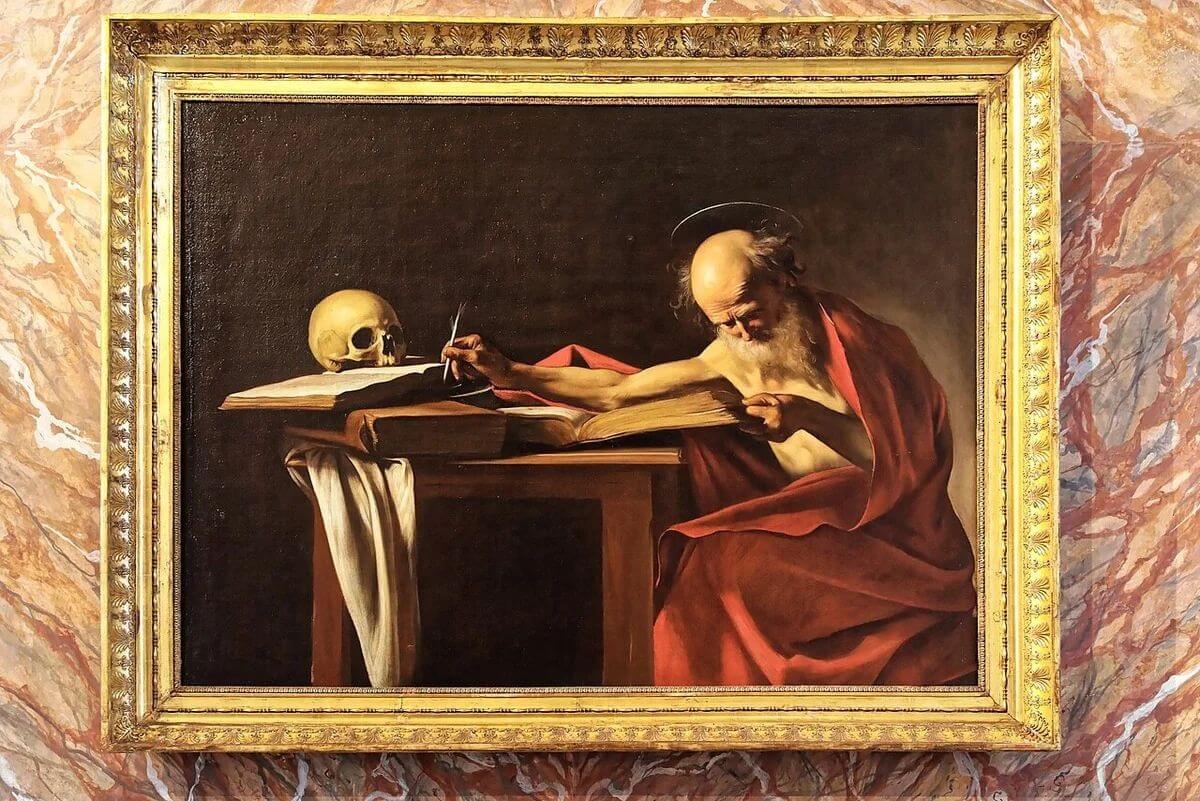
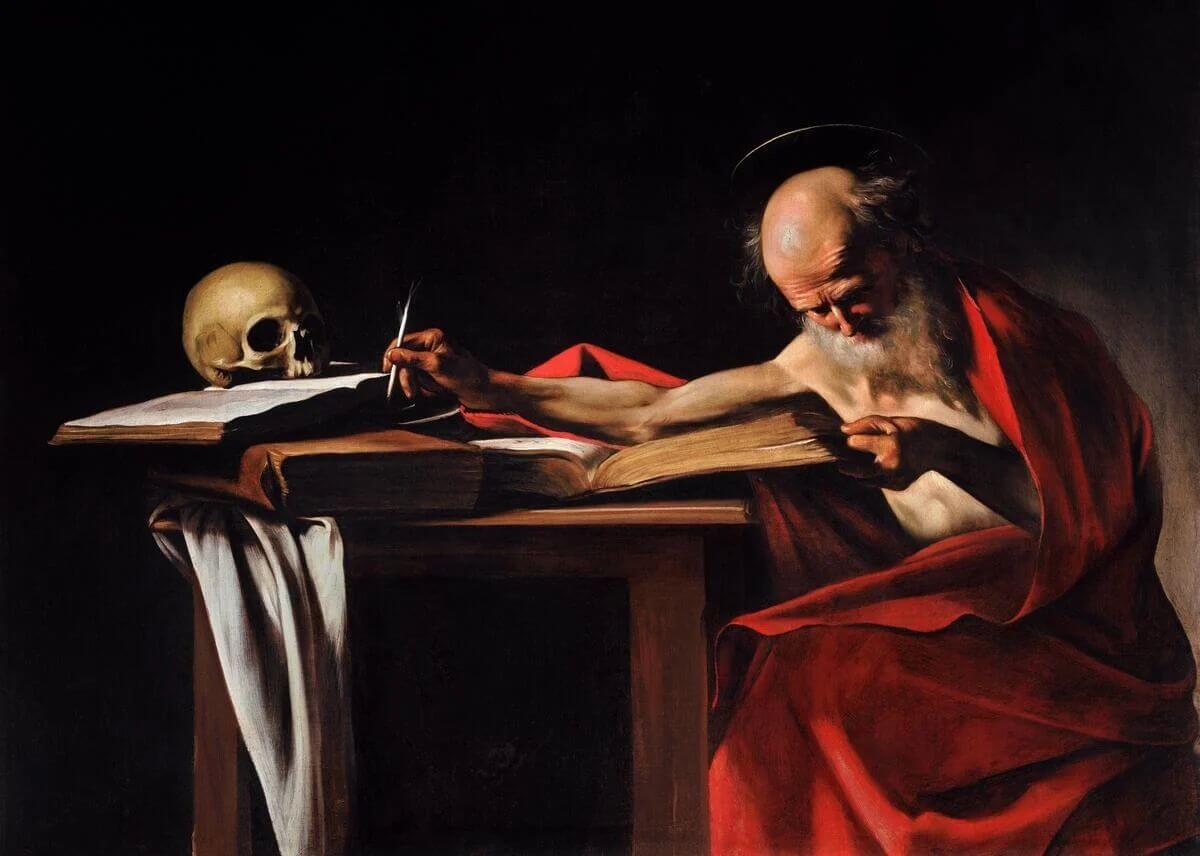
A thin arm stretches across the books toward a skull on the far side of the table. In Saint Jerome by Caravaggio, the elderly saint keeps his eyes lowered to an open volume while his hand holds a quill. His red cloak leaves part of his chest bare, and a faint halo curves above his head.
Painted around 1606, this Saint Jerome Writing belongs to the Borghese Gallery in Rome. Caravaggio painted a separate Saint Jerome Writing now in Valletta, Malta.
Saint Jerome by Caravaggio: Key Facts
- Artist: Caravaggio (Michelangelo Merisi)
- Italian title: San Girolamo
- Date: c. 1606
- Medium: Oil on canvas
- Dimensions: 116 × 153 cm (height × width), about 46 × 60 inches
- Subject: Saint Jerome studying Scripture, with a quill and books
- Collection: Galleria Borghese, Rome; inventory number 056
- Display location: Room 8 (Silenus Room), ground floor
Why Is Saint Jerome Shown Writing?
Saint Jerome was a Christian scholar whose work helped shape the Latin Bible known as the Vulgate. He revised earlier Latin texts and translated much of the Old Testament from Hebrew. His work also drew on Greek sources. These revisions and translations, together with work continued by others, formed the Latin Bible used in the Western Church for centuries.
The books and quill identify this scholarly activity. His lowered gaze and extended writing hand bring reading and writing into the same pose.
Jerome lived in the fourth and early fifth centuries, long before the office of cardinal existed. Artists nevertheless often gave him a cardinal’s red clothing to honor his importance in the Church. Caravaggio retains the red mantle and the halo, while leaving the saint’s aged chest and shoulder exposed.
Reading Caravaggio’s Saint Jerome
The Arm, the Books, and the Skull
Jerome occupies the right side of the canvas, but his writing arm reaches almost to the skull at the left. Follow it from the shoulder through the elbow to the hand: the long, nearly horizontal movement carries your eye across the table. Below it, thick books overlap, their page edges catching the light.
The skull rests on an open book, roughly opposite Jerome’s bowed head. Its empty eye sockets and exposed bone contrast with the saint’s furrowed brow and white beard. By placing the two heads at opposite ends of the table, Caravaggio brings the living man and the remains of a human body into the same line of sight.
The skull is a memento mori, a reminder of death. Its position beside the books links the reminder of death to Jerome’s work on Scripture.
Light, Skin, and the Red Cloak
Light catches the top of Jerome’s head, the ridge of his shoulder, and the length of his arm. Shadow deepens below the arm and around the eyes, giving the thin body volume. This modeling through light and shadow is called chiaroscuro.
The red cloth gathers in broad folds around his body. At the left, a white cloth drops below the books, its bright ridges separated by dark creases. Compare those sharp folds with the softer shading across the bare shoulder: the changes in light help distinguish fabric from skin.
The background also changes. It is nearly black behind the pale skull and books, but lighter beside the dark red cloak at the right. That lighter patch makes the edge of the robe easier to follow. The space looks spare, yet its lighting carefully separates the forms.
Antonio Iommelli’s Borghese catalog entry connects the warm flesh and red mantle with the cooler skull and white cloth, proposing a dialogue between life and death.
The Painting in the Borghese Collection
Writing in 1672, Giovanni Pietro Bellori said Caravaggio made the painting for Cardinal Scipione Borghese. Its precise entry date is undocumented; Iacomo Manilli described it in the collection in 1650. Art historian Maurizio Calvesi proposed that it was a gift thanking the cardinal for legal help, a hypothesis rather than an established commission history.
The attribution changed over time. A 1693 inventory named Caravaggio, but the picture was assigned to Jusepe de Ribera in 1790, an attribution still retained by Adolfo Venturi in 1893. Caravaggio’s authorship regained broad acceptance at Roberto Longhi’s Milan exhibition of 1951.
The thin paint, briskly handled beard and robe, and changes to the figure led Maurizio Marini to consider the canvas unfinished. Mia Cinotti rejected that view in 1983.
Rome, Valletta, and Montserrat: Three Different Saint Jeromes
Caravaggio’s Saint Jerome at the Borghese Gallery is a different painting from the versions in Valletta and Montserrat.
| Painting | Collection | A useful visual clue |
|---|---|---|
| Saint Jerome, c. 1606 | Galleria Borghese, Rome | The saint sits at the right; his arm stretches left toward the skull across a wide table. |
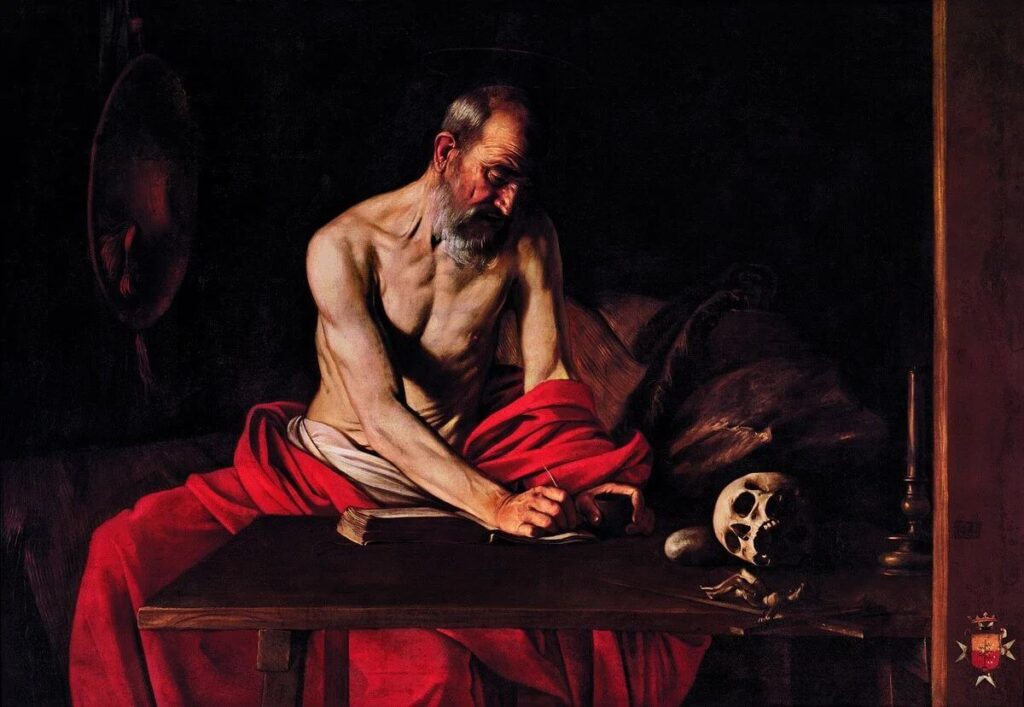
| Saint Jerome Writing, c. 1607 | St John’s Co-Cathedral, Valletta, Malta | His torso is more frontal, both hands are close to the book, and the skull is at the right. |
| Penitent Saint Jerome (also known as Saint Jerome in Meditation), 1605 | Museum of Montserrat, Spain | A vertical composition: the seated saint bends toward a skull, without the long writing gesture across a table. |
In the Valletta painting, three additional details help identify the work: a cardinal’s hat hanging at the left, a candlestick at the right, and a coat of arms in the lower-right corner.
How to See Saint Jerome at the Borghese Gallery
Saint Jerome is displayed in Room 8, the Silenus Room, on the ground floor of the Borghese Gallery in Rome.
Start a few steps back to follow the arm from Jerome’s bowed head toward the skull across the table. Then move closer to compare the sharp, brightly lit folds of the white cloth with the softer shading on his bare shoulder.
In the same room, Caravaggio’s David with the Head of Goliath also directs attention between two heads through an extended arm. David looks down at the head hanging from his hand; Jerome’s attention stays on his book, with the skull set farther away across the table.
Practical information
- Opening hours: Tuesday–Sunday, 9 a.m.–7 p.m. Last admission is at 5:45 p.m.
- Visit duration: Standard museum visits last two hours. The final 5:45 p.m. entry allows 75 minutes.
- Closures: Mondays, January 1, and December 25. Check the museum’s official visitor information for exceptions and temporary closures.
- Reservations: A timed reservation is required for all visitors, including those eligible for free admission.
- Tickets: Access to the painting is included with museum admission; no separate ticket is needed.
 Check our Borghese Gallery tickets page for booking options. To plan the rest of your visit, explore our Borghese Gallery artworks guide.
Sources
- Galleria Borghese — Saint Jerome: Antonio Iommelli’s catalog entry (July 2022), with the painting’s identification, provenance, attribution history, and debate over its completion.
- Getty — Talking About Paintings: Caravaggio: Davide Gasparotto and Keith Christiansen discuss the Borghese painting’s gesture, aging body, and carefully arranged lighting (May 2, 2018).
- Vatican — Scripturae Sacrae affectus: the September 30, 2020 letter explains Jerome’s work on Hebrew, Greek, and Latin biblical texts.
- National Gallery — Saint Jerome as Cardinal: background on the later artistic convention of dressing Jerome in cardinal’s robes.

Fanny, a skilled writer with a keen interest in art and culture, has been enchanted by the Borghese Gallery’s exquisite collection and its history. As a significant contributor to the Visit Borghese Gallery blog, she artfully shares insights and stories, bringing the gallery’s masterpieces and the lush gardens to life for readers around the world.