- On November 12, 2023
- In PLAN YOUR VISIT Top attractions
Capuchin Crypt in Rome: What to See and How to Visit
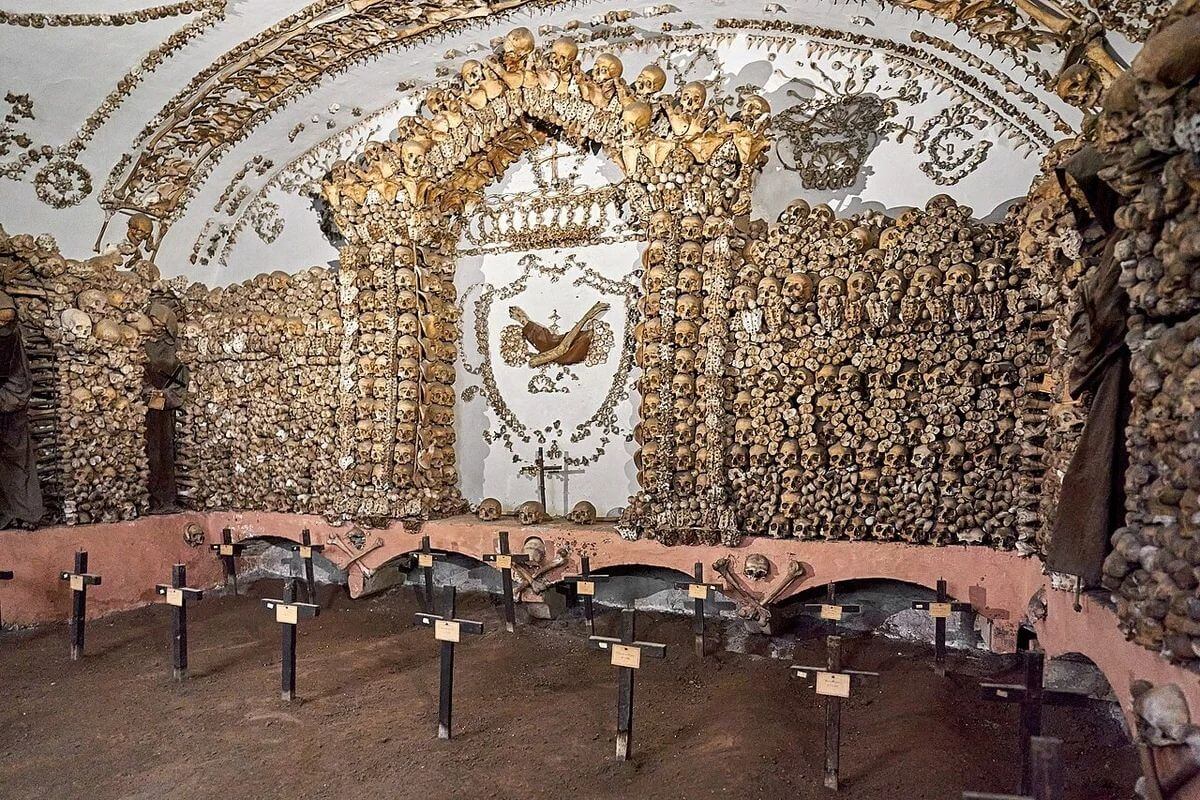
Human bones form arches and floral patterns in the Capuchin Crypt in Rome, beneath the church of Santa Maria della Concezione on Via Veneto. Looking closely at these decorations opens up the story of the Capuchin friars: how they lived, remembered their dead and expressed their hope of resurrection.
The route begins in the Capuchin Museum, with paintings and objects from the friars’ daily and religious lives, before leading into the chapels. Here’s how to follow that story through the visit, understand the details that catch your eye and plan your stop near Piazza Barberini.
Capuchin Crypt: Key Facts
- Location: Via Vittorio Veneto 27, near Piazza Barberini in central Rome.
- What’s included: The museum and crypt are visited together; there is no crypt-only ticket.
- Admission: €10 standard, including an audio guide; add €1.50 per ticket when booking online.
- Visit length: Allow about one hour for the museum and crypt.
- Midday closure: The site closes from 1:30 to 2:30 p.m.
- Dress code: Keep shoulders and knees covered.
- Accessibility: The crypt has three steps and no ramp; powered wheelchairs are not permitted.
What to See at the Capuchin Museum and Crypt?
The Museum Before the Crypt
In the museum galleries, paintings, liturgical vestments and everyday objects trace the Capuchin friars’ way of life. The displays explore their commitment to simplicity, their care for the poor and the community behind the burial place you’ll visit next.
One painting offers a detail to carry with you into the crypt. In Saint Francis in Meditation, whose attribution to Caravaggio is debated, the saint holds a skull, with a cross lying on the ground. The skull connects his prayer to a reflection on mortality, a theme that takes a very different visual form in the chapels.
The Six Spaces of the Crypt
The crypt is an ossuary, a place where human remains are gathered. A corridor about 100 feet (30 meters) long links six spaces holding the remains of roughly 3,700 people, mostly Capuchin friars.
The room names help you read the decoration. In the Crypt of the Tibias and Femurs, bones frame arches and vertebrae form crosses. The Crypt of the Pelvis has a ceiling rosette assembled from shoulder blades and vertebrae. Individual bones become parts of larger patterns.
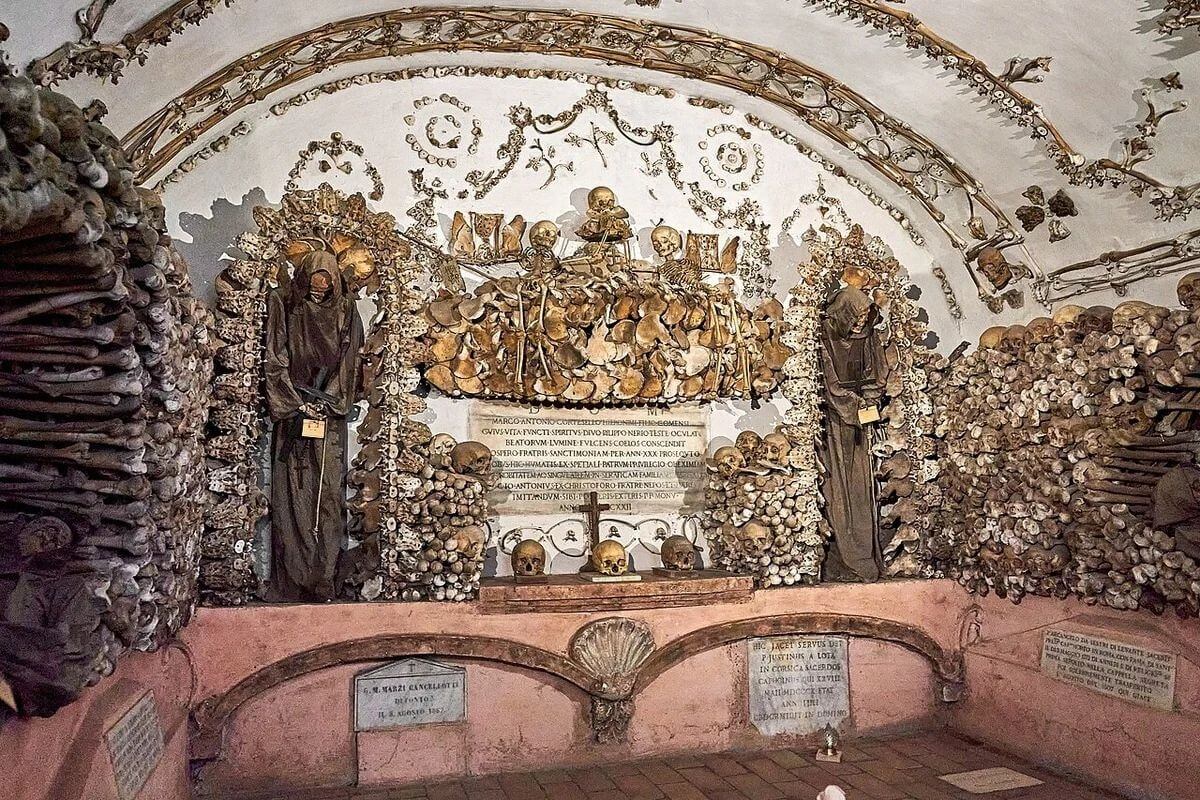
In the Crypt of Skulls, a winged hourglass recalls the passing of time. In the Crypt of the Three Skeletons, a central figure with a scythe and scales evokes death and judgment.
The Mass Chapel has an altar for prayers for the dead. In the Crypt of the Resurrection, a painting of the raising of Lazarus adds the Christian promise of life beyond death. These spaces place the crypt’s memento mori, or reminder of death, within a belief in resurrection.
The Church Above the Crypt
The church of Santa Maria della Concezione dei Cappuccini offers another part of the friars’ artistic world. Its single nave is lined with raised side chapels, and the altar paintings include Guido Reni’s Saint Michael the Archangel.
Tomb slabs cover the floor, including that of Cardinal Antonio Barberini near the main altar steps. The church is a separate place of worship with its own opening hours and services, so allow for it as an additional stop.
The History Behind Rome’s Bone Chapels
The Capuchins’ new home on Via Veneto also became a resting place for their dead. Construction began in 1626, with the support of Pope Urban VIII and his brother, Cardinal Antonio Barberini, himself a Capuchin. The friars settled there in 1631, and the remains of brothers buried at their former convent of San Bonaventura were transferred to the crypt.
Who created the bone decorations, and exactly when, remains uncertain. A tradition also holds that soil was brought from the Holy Land for the cemetery.
The neighborhood changed around the friars. The old convent was demolished during redevelopment, while the church and crypt survived. Work on a new convent began in 1925. The museum opened in 2012 in rooms of the convent, connecting the surviving crypt with displays about the order’s history.
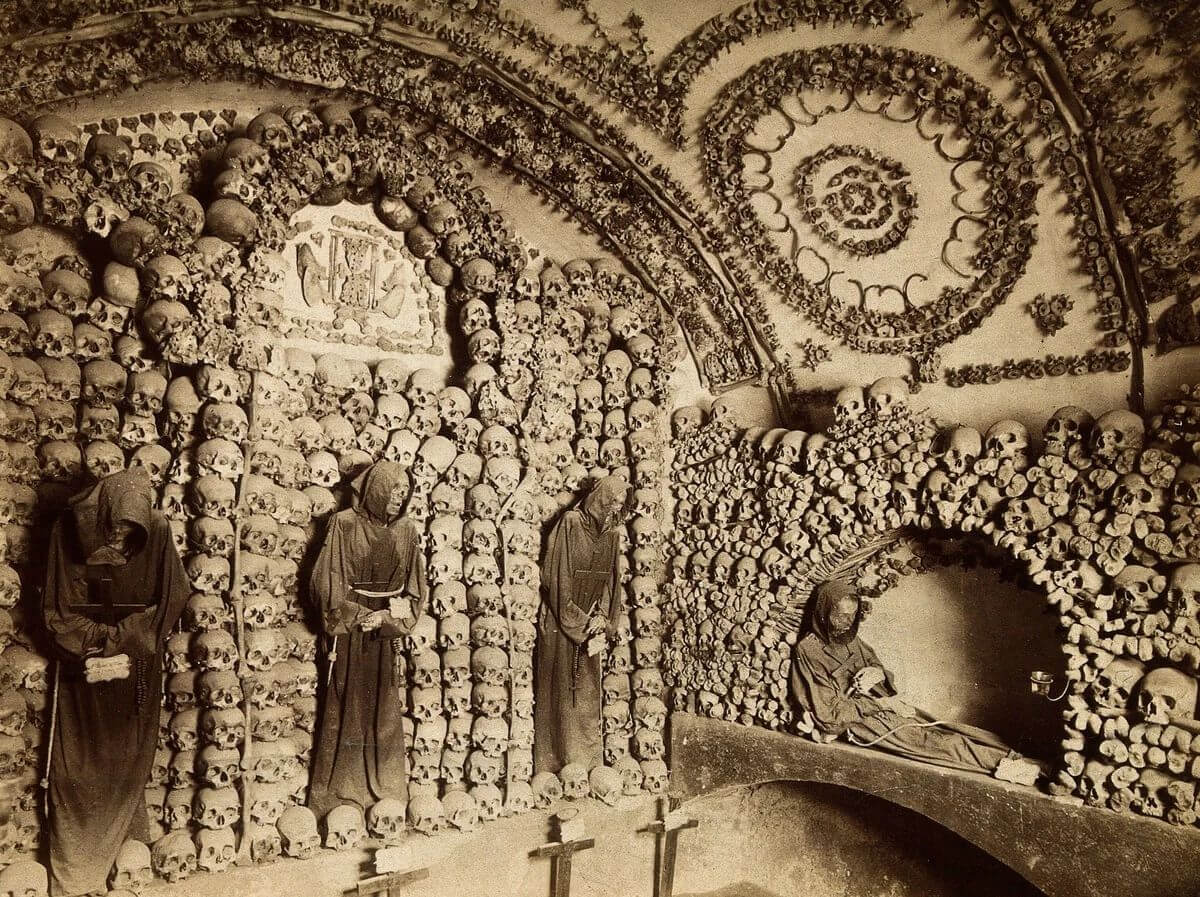
Is the Capuchin Crypt Worth Visiting?
The Capuchin Crypt is worth visiting if you enjoy religious history and discovering the meaning behind unusual works of art. Following the friars’ story from the museum to the chapels lets you connect the bone decorations with their beliefs about life and death. Allow about an hour for the museum and crypt together, making this a focused stop near Piazza Barberini.
The deciding factor is how you feel about real human remains. Skulls and skeletons are central to what you’ll see. If you expect them to be distressing, this may be a visit to leave out of your itinerary.
For families, explain beforehand that the bones are real and consider each child’s sensitivity. The museum recommends that minors enter the crypt with an adult.
Capuchin Crypt or Roman Catacombs: What’s the Difference?
- Capuchin Crypt: This ossuary lies beneath a church on Via Veneto, where human bones form the decoration. The visit combines the friars’ museum and bone chapels, exploring their beliefs about life and death. You can follow the route with an audio guide or choose a guided visit.
- Roman catacombs: These are ancient underground cemeteries, with galleries and burial niches cut into the rock. At Saint Callixtus, tomb inscriptions help you trace an early Christian community. Visits there are guided, following a set route through the burial spaces. Saint Callixtus is on the Appian Way, outside the historic center, so visiting it involves a separate journey from Via Veneto.
The Capuchin Catacombs of Palermo, known for their mummified bodies, are a separate destination in Sicily.

Capuchin Crypt Tickets and Guided Tours
Official Tickets, Prices and Booking
Admission includes the museum, crypt and audio guide. Buy through this official reseller ticket page or at the museum:
- Standard: €10.
- Reduced: €6.50, including visitors ages 7–17, those over 65 and students with proof of status.
- Groups: €7.50 per person for 10 or more.
- Free admission: Children 6 and under, plus visitors with disabilities and one companion. For disability admission, bring supporting documentation to the ticket office; no advance reservation is needed.
Online purchases carry a €1.50 fee per ticket, bringing a standard ticket to €11.50. The official page lists the remaining concession categories.
Dated tickets are nonrefundable and cannot be moved to another date. Each ticket allows one admission; leaving ends your visit. Roma Pass is not accepted.
Choosing a Guided Visit or a Combined Tour
If you’d like to ask questions about the chapels’ symbols and history, consider a guided visit. For a museum-provided guide, email info@museoecriptacappuccini.it at least one week ahead. The guide costs €90 by bank transfer or €95 via PayPal, plus admission. Guided groups are limited to 10 people.
Two other options let you choose how much of the day to devote to the visit:
- Museum and crypt with a guide: This visit offers a 45-minute guided tour in English. Select the guided option: the same page also offers admission with an audio guide.
- Crypt and Roman catacombs with transfers: This combined tour lasts about 3½ hours, with admission to the museum, crypt and Roman catacombs, plus coach transfers between sites. The crypt portion uses an audio guide.
Opening Hours and Practical Tips
Opening Hours, Last Entry and Holiday Closures
The museum and crypt open daily, with a midday break:
- Morning: 9:30 a.m.–1:30 p.m., with last entry at 12:30 p.m.
- Afternoon: 2:30–6:30 p.m., with last entry at 5:30 p.m.
- Closed: Easter Sunday, December 25 and January 1.
- Morning opening only: Holy Saturday, November 2, December 24 and December 31, closing at 1:30 p.m., with last entry at 12:30 p.m.
Dress Code and Photography
Keep shoulders and knees covered when entering the crypt.
Photos and video are allowed for private, noncommercial use. Publication or commercial use requires authorization.
Accessibility and Bags
The museum has an elevator; ask reception staff for access. The crypt has three steps and no ramp, and powered wheelchairs are not permitted there.
 Use the free lockers for large bags and suitcases; food and drinks are not allowed in the rooms, except for a small bottle of water.
How to Get to the Capuchin Crypt?
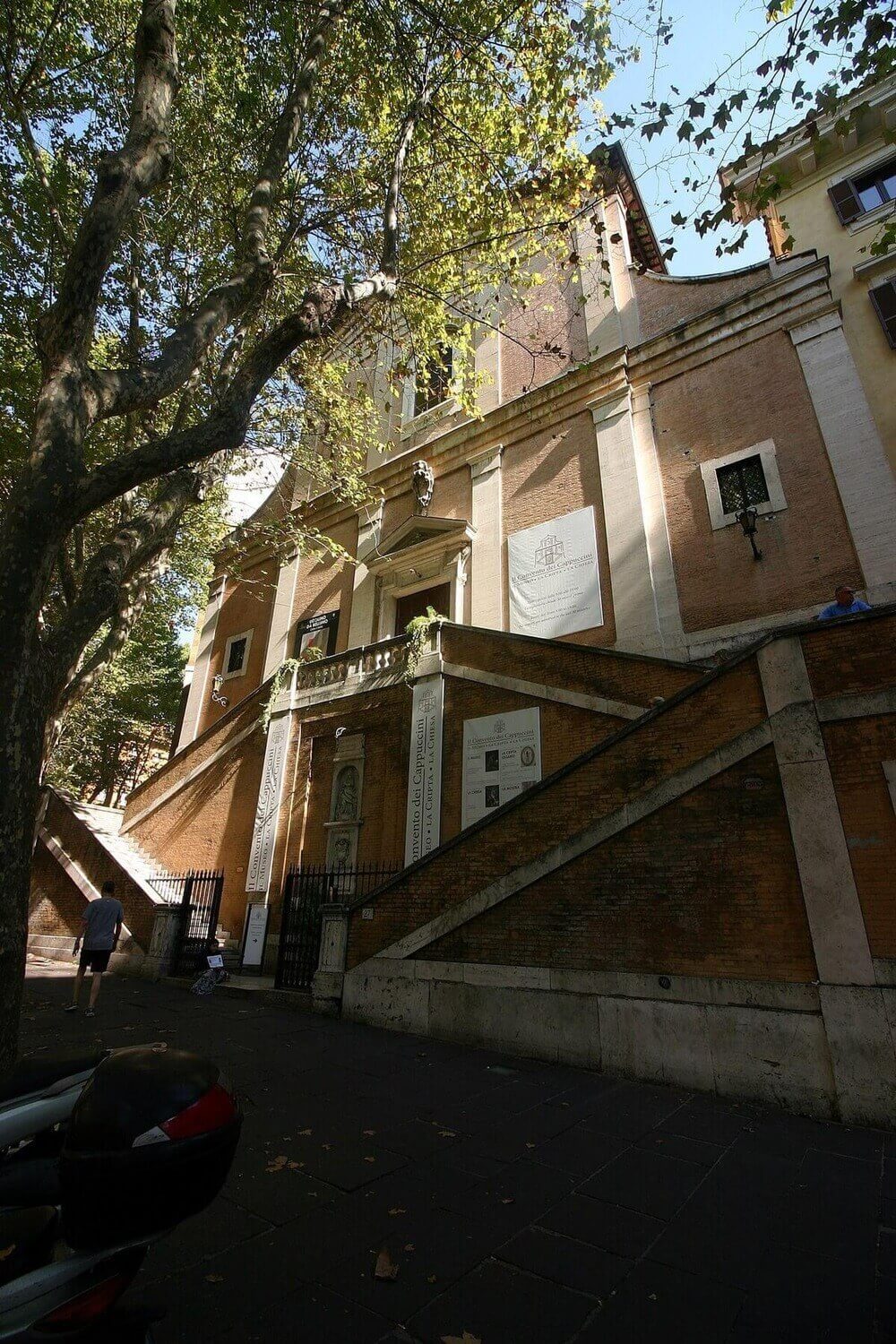
You’ll find the Capuchin Museum and Crypt at the Piazza Barberini end of Via Veneto, beneath the church of Santa Maria della Concezione dei Cappuccini.
Address: Via Vittorio Veneto 27, 00187 Rome.
- By metro: Take Line A to Barberini, then follow Via Veneto from the square to number 27.
- On foot from Villa Borghese: From the Porta Pinciana side of the park, follow Via Veneto toward Piazza Barberini.
What to See Near the Capuchin Crypt?
From Piazza Barberini, you can continue with Bernini’s fountains and a painting collection, or head uphill toward the gardens.
- Piazza Barberini: At the center of the square, Bernini’s Triton Fountain shows a sea god blowing into a conch shell, seated on a larger shell supported by dolphins. His smaller Fountain of the Bees, at the start of Via Veneto, repeats the Barberini family’s bee emblem.
- Palazzo Barberini: For more painting, head to this Baroque palace on Via delle Quattro Fontane, whose collection includes Raphael’s La Fornarina.
- Villa Borghese Gardens: Follow Via Veneto uphill toward Porta Pinciana for a walk among tree-lined paths and fountains. With more time, continue into the park toward the lake and the Temple of Asclepius, where a small temple stands on an island.
- Piazza di Spagna: The Spanish Steps sweep upward from the square toward Trinità dei Monti, with the boat-shaped Barcaccia Fountain at their foot. This stop fits naturally into a walk toward Villa Medici.
- For a visit to Renaissance architecture and gardens, continue toward Trinità dei Monti and Villa Medici. Its historic gardens and rooms are visited on guided tours.
- Terrazza del Pincio: For a longer walk, continue beyond Villa Medici to this terrace above Piazza del Popolo. From the balustrade, the view opens across Rome’s rooftops toward St. Peter’s dome.

Fanny, a skilled writer with a keen interest in art and culture, has been enchanted by the Borghese Gallery’s exquisite collection and its history. As a significant contributor to the Visit Borghese Gallery blog, she artfully shares insights and stories, bringing the gallery’s masterpieces and the lush gardens to life for readers around the world.